Questions this playbook answers
- Is personalized print and direct mail worth doing in an AI-first program, or is it a legacy channel?
- When every piece has a print and postage cost, how do we decide who gets one, and who gets nothing?
- What can AI generate for a printed piece without inventing things, and what should never go on paper?
- A printed mistake cannot be recalled. What has to happen before anything goes to the printer?
- How do we measure a channel whose responses arrive by phone, by typed URL, and weeks later?
The moment
Larkspur Systems is a fictional composite company used throughout this handbook: field-service and fleet software, about 40,000 accounts and 250,000 contacts, and a small direct-mail program.
September, the planning meeting for renewal season. About 10,000 Larkspur accounts renew in the next quarter. Marketing proposes a printed "Fleet Year in Review": a short booklet for each account, showing its own year on Larkspur (vehicles dispatched, routes optimized, hours of idle time flagged), with a personal note from the account manager and a QR code to a page that continues the conversation. A digital press can print every copy differently. A model can write every note.
Finance asks the question email never forced anyone to ask. At an assumed $3 to $6 all-in per booklet (digital print, a mailing envelope, postage, and proofing time; my working range, not a quote), the full quarter costs $30,000 to $60,000. The email version of the same idea costs almost nothing per send. So: who is each booklet for, and what will it change?
That question is the gift of the physical channel. Postage alone on a presorted US marketing letter runs 37 to 47 cents as of July 2026 [1]. Every piece is a line item.
The decision
Here is the sentence this playbook turns on: in print, every decision to act has an invoice, and every mistake has a shelf life. Both halves change how the decision layer (Chapter 14) should behave.
The first half makes "who is worth it" concrete. Chapter 4 reduced the economics of attention to one calculation: what a better decision is worth, times how likely the approach is to produce it, minus what it costs. In email the cost term is near zero, so teams skip the arithmetic. In print you cannot. The rule for each account:
send if (expected change in outcome because of this piece) x (value of that outcome) > (cost of the piece, including review time)
Run it for two Larkspur accounts, with illustrative numbers. A two-truck plumber paying $1,200 a year: at $5 a piece, the booklet must raise the chance of renewal by more than about 0.4 percentage points to pay for itself. A 400-vehicle fleet paying $60,000: the same booklet needs less than a hundredth of a percentage point. The cost term barely registers.
That second result is the honest surprise. In high-value B2B, postage rarely decides who is worth it. The sign of the effect does. The expected change can be negative. Chapter 14 described Dana, whose dispatch board was broken while a campaign queued an upsell. A glossy booklet celebrating her "year on Larkspur," landing on her desk during a priority-one escalation, is the same mistake in a heavier format. Uplift modeling calls her a Sleeping Dog: someone an intervention makes worse [2]. Accounts that will renew anyway are Sure Things; a booklet to them is a thank-you, worth budgeting as one, not crediting as lift. In consumer programs with $40 orders, the cost term binds hard and the same formula prunes most of the list.
So the decision for each account has more than two options:
| Option | When it wins |
|---|---|
| Send the personalized piece | Expected change is positive and exceeds cost; facts for the content are verified and appropriate for paper |
| Send the general piece | The account qualifies, but the evidence supports only an honestly general version (Chapter 15) |
| Route to a person instead | High-value account with a live issue: the account manager calls; nothing is mailed |
| Hold | Something unresolved (open escalation, pending change of contact) makes this the wrong week |
| Do nothing | No option beats the cost, or the person has objected to direct marketing |
Larkspur's final list for the quarter was about 3,500 booklets, not 10,000, plus 400 accounts routed to account managers and a randomized holdout (see "How you will know"). The number was not chosen by budget. It fell out of the rule.
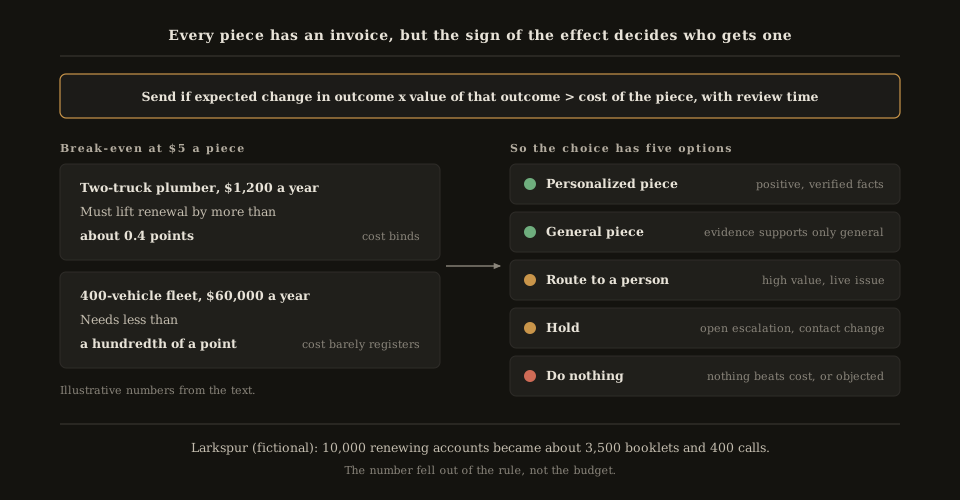
Figure M3.1. Price every piece, then let the sign of the effect, not the postage, choose among five options, including do nothing.
Email made it easy to forget that attention has a price. Print puts the price on the invoice.
What you need to know
Print needs everything a digital message needs, plus an address that is current, a person who is still there, and facts that will still be true when the piece arrives.
Address, with provenance and a date. In the US, mailers claiming presorted First-Class or USPS Marketing Mail prices must update their lists against change-of-address records within 95 days before the mailing date, using an approved method such as NCOALink [3]. That is a floor, not a standard. In B2B the harder problem is that an office address tells you where a company receives mail, not where your contact works. Store the mailing address as a property with its source, its last verification date, and whether the person confirmed it (Chapters 10 and 11). If the only address is one an enrichment vendor supplied, treat it as a hypothesis (Chapter 7).
The right person at that address. Identity resolution matters more on paper because the piece outlives the error. A booklet addressed to a contact who left in the spring does not bounce; it sits in someone else's inbox tray, addressed to a former colleague, full of account data (Chapter 9). Role freshness (Chapter 11) is a selection criterion, not a nice-to-have.
Facts that survive the trip. A print piece is decided days or weeks before it is read (Chapter 17 gives direct mail a latency budget of days). The data is frozen at a print cutoff. So choose content facts with a long half-life: the year's totals, the plan they are on, the region they expanded into. Avoid anything framed as recent ("last week your team...") and anything volatile (open ticket counts, usage this month). "As of" dates belong on the page.
Suppression state, twice. Consent and objections, open escalations, legal holds, and contact budgets are hard constraints (Chapter 14), checked at selection and checked again at the drop date, because the list you selected on Monday is not the list that should be mailed on Friday.
The memory shape follows the Boundary Rule from Chapter 10. Selection runs on typed properties: renewal date, account value, open P1, address verified date, objection flag. Those go in a WHERE clause. Content draws on evidence-level memories with provenance: what the account achieved, which region they added, what the account manager wants to say. Those go in a paragraph. At the print cutoff, the system writes a print manifest: for each piece, the exact facts used, their sources and dates, the template version, and the decision reason. When a customer calls about something printed, the manifest is how you answer. In the self-hosted memory system I built, every superseded property value is kept with its valid-from and valid-to dates, so "what did we believe on the cutoff date" is a query, not archaeology.
The action
Generate zones, not pages. A booklet is a set of typed zones (Chapter 15): the cover line, the account's year in numbers, one insight, the account manager's note, the call to action. Numeric zones are not generated at all; they are pulled from the warehouse by code and formatted by the template. In the governed personalization engine I built, a provider's bucket floor or a headcount that contradicts other evidence is marked untrusted and hidden before any surface sees it. Hide when uncertain: a blank beats a confident wrong number. The model writes only the prose zones, under a generation contract: allowed evidence, forbidden claims (prices, discounts, commitments, anything about the person rather than the account), length, tone, and a general fallback per zone. When evidence thins, specificity steps down (account, then segment, then approved static copy) before trust does; if nothing verifiable remains, the piece is not printed. The account manager's note is drafted for the manager to edit and approve; it carries their name, so it carries their approval.
Compile for paper. Chapter 15's channel compiler applies the surface's contract, and paper has a strict one. The outside of an envelope or a postcard is read by a mailroom, a receptionist, and anyone at the desk. Nothing but name, title, company, and address goes there. Inside, use only facts the recipient would expect Larkspur to know from running their account (Chapter 19's say-how-we-know test). Operational data from their own dashboard passes. Anything inferred about the person, anything from enrichment, and anything sensitive does not go on paper at all, because paper travels.
Render to a print-ready file, then check that file. Variable data printing produces one file in which every page can differ; PDF/VT (ISO 16612-2) is the standard exchange format for it [4]. QA runs on the rendered PDF, not on the database rows (Chapter 20), because the defects that matter live in rendering: an overflowed text box, a missing image, a literal {fleet_size}, a chart on the wrong account. Once checked, the file is frozen with its manifest. If the transfer to the printer fails, resend that exact file; never regenerate, because a second generation is a different set of pieces from the one you proofed.
Make the response path a continuation. A QR code or personalized URL (PURL) should open a page that continues from the booklet, not a generic homepage (Playbook M1). Two rules. The link must use an unguessable token, not the person's name: a URL like /j-morales lets anyone who guesses a name see a page built from someone's account data. And the page should show nothing beyond what was printed until the visitor signs in or confirms who they are. The chain should continue past the page: a scan is an engagement signal, written back to the account's memory, that can trigger the account manager's alert or the next email.
Reserve the expensive hour for the signal. The booklet is the cheap wide pass. The account manager's call is the expensive one, and it goes first to the accounts that scan, call, or reply, and to the 400 routed accounts that never got a booklet. The expensive hour is not spent on the guess; it is reserved for the signal (Chapter 4).
The design: print as one more compiled surface
The engine I built already runs, for web pages, email, and seller briefs, the parts print needs: account memory, campaign governance, typed zones with fallbacks, trust rules, rendering safety, and campaign-wide QA. Print on top of it is a design, not a shipped product. The first version I would build:
- An approved print template, designed by people. Not AI graphic design.
- Declared zones: headline, account framing, the letter, approved proof, call to action, QR code.
- The same context and governance as the digital surfaces, so the booklet cannot contradict the landing page.
- Generate or select zone content under tighter character budgets and paper's stricter privacy rules.
- Deterministic preflight with stricter thresholds and approvals than web copy, which can be fixed tonight.
- A print-ready render (PDF/VT), checked as rendered.
- Fulfillment of the frozen file, after the release gate.
Print is not a separate marketing tool. It is one more surface compiled from the same governed context.
From the field: a personalized print deployment
What can go wrong
Failure story: The Unrecallable Batch. Larkspur's first attempt, a year earlier, was a printed renewal letter to 2,400 accounts. The team reviewed 20 proofs; all were good. The file went to the printer on a Thursday. By the following week, three things were in customers' hands. On 212 letters, the "vehicles in your fleet" figure read 10,001, a data provider's bucket floor that no rule had rejected. Thirty-one letters went to contacts who had left their companies; one congratulated an operations lead who had left after a public dispute on "your team's best year yet," and her former colleagues opened it. And six went to accounts with open priority-one escalations, because the suppression list was pulled at selection and never refreshed before the drop.
Every one of those defects would have been caught by the checks in Chapter 20. In email, the team would have fixed the template and sent a correction within the hour. On paper there is no correction. The letters sat on desks for weeks.
An email error is a correction. A print error is a keepsake.
The pre-print protocol that replaced it:
- Deterministic checks on 100% of rendered pages: placeholder text, overflow, rejected values (bucket floors, impossible ranges), numbers matched against the warehouse, links and QR codes resolved and tested.
- Semantic review by an AI judge on every flagged piece plus a stratified sample of clean ones, against the generation contract (Chapter 20).
- Human proof of a stratified sample, including the thin-data accounts and every template variant, on paper, because color, cropping, and legibility look different printed.
- Suppression and identity refresh at the drop date, not only at selection. Anything that changed is pulled.
- Seed pieces addressed to internal staff in several regions, to see what actually arrives and when.
- A release gate. Sending the file to the printer is the irreversible action in this channel. It passes a gate that can say no, owned by a named person (Chapter 14's Consequence-Gated Autonomy; Chapter 18). Make the verdict explicit (GO, GO WITH FIXES, NO GO); in my engine's campaign QA, a blocker gets an independent, skeptical second check before it can force NO GO.
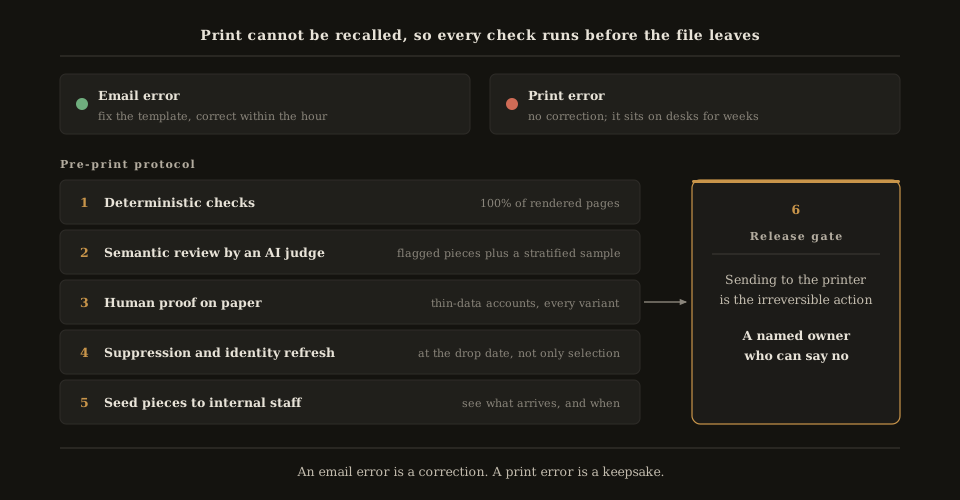
Figure M3.2. Print cannot be recalled, so every check runs before a named owner releases the file.
Other risks, briefly:
- Consent is different, not absent. In the EU, postal direct marketing can rest on legitimate interests (GDPR Recital 47), unlike most email marketing, but the right to object to direct marketing is absolute (Article 21), and an objection must suppress print as fast as it suppresses email [5]. Keep one objection flag that every channel reads. Not legal advice; see Chapter 19's dated notes.
- The handwritten illusion. Machine "handwriting" signed by a manager who never saw the note is a trust debt. If it carries a person's name, that person approves it.
How you will know
Hold out at random, before selection runs out. From the accounts the rule selected, Larkspur held back a random group that received nothing in print (the account manager could still call if the account signaled). The comparison is selected-and-mailed versus selected-and-held-out. Comparing responders with non-responders, or this year with last year, measures selection, not effect (Chapter 21).
Measure outcomes, not scans. QR and PURL tracking is now the norm: in the ANA's 2023 survey, 82% of those who track direct-mail response use QR codes, personalized URLs, or another online mechanism [6]. That is attribution, not incrementality. It undercounts (people call, type the main address, or mention it to their account manager a month later) and credits the piece for Sure Things who would have renewed anyway. Use renewal and expansion rates by arm, with matchback of all responses, and track complaints and objection requests as a guardrail.
Size it honestly. With 1,500 accounts per arm and an 85% baseline renewal rate, the smallest difference you can reliably detect (5% significance, 80% power) is roughly 3.5 percentage points. That is a large effect for one mailing. Measure a nearer, more frequent outcome (renewal conversations within 30 days), pool quarters, or say plainly that the program cannot yet prove its effect.
What the evidence does and does not say. Print is easy to oversell, and the most quoted numbers are weaker than they look.
- The ANA 2023 Response Rate Report ranked direct mail to house lists first on ROI among the media it covered, at 161%, against 34% for mail to prospect lists, with average response rates of 15.6% (house) and 10.8% (prospect) [6]. It is a self-reported online survey of 250 respondents, fielded July to November 2023, and each of those direct-mail figures rests on 22 to 26 answers, several flagged "small base" by the ANA itself, with many respondents giving estimates rather than actual metrics. Read the direction: mail to people who already know you tends to outperform mail to strangers. Do not plan a budget on the level.
- Postal neuromarketing studies are supportive, not decisive. Canada Post's 2015 study (270 participants, mock brands, commissioned by Canada Post) reported that direct mail took 21% less cognitive effort to process and produced 70% higher brand recall than digital [7]. The USPS Office of Inspector General's 2015 study with Temple University (56 participants in the exposure phase, 39 in the brain-imaging phase) found that digital ads captured attention faster while physical ads were remembered better and triggered more activity associated with valuation; it also found that participants' self-reported attitudes showed little difference between the formats [8]. Small samples, laboratory settings, and sponsors with an interest in the answer.
- I found no peer-reviewed field experiment measuring the lift of variable-data printing or PURLs themselves. Claims such as "PURLs lift response 500%" have no traceable primary source; I do not use them.
The defensible evidence comes from adjacent field experiments, and it points in a useful direction. Adding a recipient's name to an email subject line raised opens and reduced unsubscribes in randomized trials (Chapter 1) [9]: shallow personalization works a little. More instructive for print is a fundraising experiment by Adena and Huck, who mailed 10,004 letters for an opera house's youth program. Setting each recipient's matching threshold relative to their own past or predicted giving outperformed uniform thresholds; for past donors, random uniform thresholds had no detectable effect on returns [10]. What worked was not the name on the letter. It was that the letter carried a decision made for that person.
Personalize the decision the piece carries, not the decoration on it.
Reader Q&A
Is print worth it for a B2B software company? For a selected set of existing customers at a meaningful moment (renewal, a milestone, a region launch), it can be, and the evidence, weak as it is, favors house lists over prospecting. Prove it with a holdout before scaling.
Should the cover say the customer's name in large type? Name personalization is the cheapest rung (Chapter 4) and helps a little. On paper it also tells everyone at the desk who the piece is for. A verified fact about their year does more work than their name in 72-point type.
Can AI design each piece? Let it choose among approved layouts and modules and fill prose zones, never free-form layouts or images: you cannot proof what you cannot predict, or recall what you printed.
Does this apply to other traditional channels? Yes: packaging inserts, statements, printed event materials, outbound calls. Wherever a touch is costly or cannot be taken back: price the decision, verify before release, hold some people out.
For your AIThis playbook's concepts, patterns and checklists as structured data. Paste it into your assistant.
playbook: M3
title: "Marketing III: The Physical Channel"
question: "When each touch costs real money, who deserves one and what should it say?"
foundation_links: [4, 7, 9, 10, 11, 14, 15, 17, 18, 19, 20, 21]
concepts:
  - name: Priced decision
    definition: "Send a physical piece only if expected incremental change in outcome times its value exceeds the full cost of the piece, including review time."
  - name: Sign over cost
    definition: "In high-value B2B the print cost rarely binds; whether the piece helps or harms (Sleeping Dogs, open escalations) decides who should receive it."
  - name: Shelf life of an error
    definition: "A printed mistake cannot be recalled or corrected, so verification must be complete before release."
  - name: Print manifest
    definition: "A per-piece record written at the print cutoff: facts used with sources and dates, template version, and decision reason."
  - name: Paper is a public surface
    definition: "Printed content can be read by people other than the addressee; the privacy contract for print is stricter than for email."
  - name: Long half-life facts
    definition: "Print content should rely on facts that remain true between data freeze and delivery, with as-of dates."
  - name: Print as a compiled surface
    definition: "Design, not shipped: approved template, declared zones, shared context and governance, zone content, deterministic preflight, print-ready render, fulfillment of the frozen file."
  - name: Hide when uncertain
    definition: "A suspicious value (bucket floor, implausible range, contradicted by evidence) is left off the piece."
decision_rules:
  - if: "a numeric value is suspicious or contradicts other evidence"
    then: "hide it and step the zone down to segment or static copy; if nothing verifiable remains, do not print"
  - if: "transfer of an approved print file to the printer fails"
    then: "resend the exact frozen file; never regenerate content after proofing"
  - if: "expected change x outcome value <= cost per piece"
    then: "do not mail; consider email, a general piece, or nothing"
  - if: "the account has an open escalation, legal hold, or recent objection"
    then: "suppress print; route to the account owner if the account is high value"
  - if: "the mailing address or contact role has not been verified within the freshness policy"
    then: "do not print account-specific content; verify, fall back to a general piece, or skip"
  - if: "a fact is volatile (current usage, open tickets, 'recent' events)"
    then: "exclude it from print content"
  - if: "content would appear on the outside of the piece"
    then: "allow only name, title, company, and address"
  - if: "a print file is ready for release"
    then: "require 100% deterministic checks on rendered pages, semantic review of flags plus a stratified sample, human proof of a sample, suppression refresh at drop date, and a named release approver"
  - if: "a QR code or PURL links to a personalized page"
    then: "use an unguessable token and show nothing beyond the printed content until the visitor is verified"
  - if: "a note carries a person's name or signature"
    then: "that person approves it"
assessment_questions:
  - "What does one physical piece cost you all in, and how is the recipient list chosen today?"
  - "When was each mailing address last verified, and against what source?"
  - "Is suppression (objections, escalations, departed contacts) refreshed between selection and drop date?"
  - "What checks run on the rendered print file, and on what share of pages?"
  - "Do you hold out a random share of selected recipients, and what effect size can your volume detect?"
  - "Which facts are allowed on paper, and who decided?"
patterns: [Priced Decision, Print Manifest, Pre-Print Release Gate, Do-Nothing Option, Wide Then Deep, Channel Compilers, Frozen Print File]
anti_patterns: [The Unrecallable Batch, Mail-Everyone-Eligible, Scan-Rate-as-Lift, Guessable PURL, The Handwritten Illusion]
metrics:
  primary: "incremental renewal or expansion rate, mailed vs randomized holdout"
  process: ["pre-print defect rate by layer", "undeliverable rate", "share of pieces falling back to general content"]
  guardrails: ["complaints and direct-marketing objections", "post-drop defects reported by recipients or staff"]
maturity_dimension: experience_generation
References
- United States Postal Service, Price List Notice 123, effective 2026-07-12. USPS Marketing Mail commercial automation letters: $0.374 (5-digit, DSCF entry) to $0.467 (mixed AADC). https://pe.usps.com/text/dmm300/notice123.htm
- Radcliffe, N. J., and Simpson, R. (2008). "Identifying who can be saved and who will be driven away by retention activity." Journal of Telecommunications Management 1(2). https://stochasticsolutions.com/pdf/SavedAndDrivenAway.pdf
- USPS PostalPro, "Move Update" (accessed 2026-09-26). https://postalpro.usps.com/address-quality/moveupdate
- ISO 16612-2:2010, "Graphic technology: Variable data exchange, Part 2: Using PDF/X-4 and PDF/X-5 (PDF/VT-1 and PDF/VT-2)." https://www.iso.org/standard/46428.html
- Regulation (EU) 2016/679 (GDPR), Recital 47 and Article 21. https://gdpr-info.eu/recitals/no-47/ ; https://gdpr-info.eu/art-21-gdpr/
- ANA, "Response Rate Report 2023: Performance and Cost Metrics," published 2024-02-22. Self-reported online survey, n = 250, fielded July to November 2023. https://www.ana.net/miccontent/show/id/rr-2024-02-ana-response-rate-report-2023 ; PDF copy: https://theworldsgreatestmarketing.com/wp-content/uploads/2025/04/rr-2024-02-ana-response-rate-report-2023.pdf
- Canada Post, "Direct mail beats digital advertising in driving consumers to act: neuromarketing study," 2015-08-27. Conducted by True Impact; commissioned by Canada Post. https://www.canadapost-postescanada.ca/cpc/en/our-company/news-and-media/corporate-news/news-release/2015-08-27-direct-mail-beats-digital-advertising-in-driving-consumers-to-act-neuromarketing-study
- USPS Office of Inspector General, "Enhancing the Value of Mail: The Human Response," RARC-WP-15-012, 2015-06-15, with Temple University's Center for Neural Decision Making. https://www.uspsoig.gov/sites/default/files/reports/2023-01/rarc-wp-15-012.pdf
- Sahni, N. S., Wheeler, S. C., and Chintagunta, P. (2018). "Personalization in Email Marketing: The Role of Noninformative Advertising Content." Marketing Science 37(2). https://pubsonline.informs.org/doi/abs/10.1287/mksc.2017.1066
- Adena, M., and Huck, S. (2022). "Personalized fundraising: A field experiment on threshold matching of donations." Journal of Economic Behavior & Organization 200:1-20. https://www.sciencedirect.com/science/article/abs/pii/S0167268122001585 ; working paper (WZB, verified text): https://www.econstor.eu/bitstream/10419/256795/1/1801895139.pdf
This playbook is a working draft. If something is wrong or missing, tell me on LinkedIn.
Get chapters by email as they are revised