Point a capable AI agent at your CRM and tell it to work the pipeline. At ten records it looks like magic. At ten thousand it comes apart, because the agent has no memory of what it learned yesterday and no sense of how your company actually works. CRM AI Operators is the open-source pattern I built to close that gap, and the whole idea fits in one line: a subagent per record.
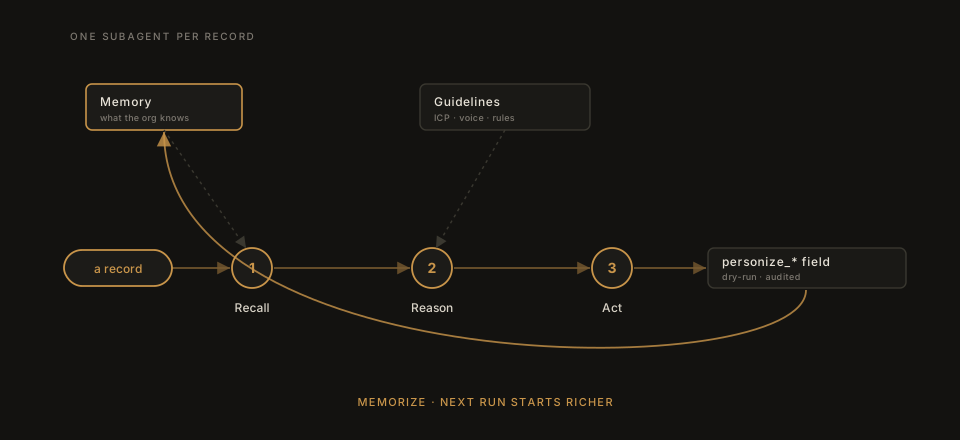
Each record gets its own subagent. Before it does anything, it recalls what the org already knows about that contact or company, and it inherits the org's judgment: the ICP, the brand voice, the compliance rules, the opt-outs. Then it plans, gathers, reasons, and acts, and it writes back only into its own namespaced fields, never on top of human-entered data, with a full audit trail and dry-run on by default. When it finishes, it memorizes what it learned, so the next run starts richer than the last.
The quiet inversion underneath: the memory is the source of truth, and the CRM is just the write surface. Most "AI in the CRM" tools treat the database as the brain. Here the brain is the governed memory layer, and the CRM is where the agent leaves a clean, auditable trace of what it decided.
It is MIT-licensed and on npm: an agent wires it in with one MCP endpoint, or a CLI for cron and CI, and starts running operations across scoring, research, generation, analysis, and write-back, against HubSpot today, with Salesforce next. I wrote more about why this shift matters in Who's Running Your CRM.