
Three ways to run a CRM: humans, humans directing agents, agents directing agents. Why only the last one changes what's possible.
Disclosure: I build in this space. Treat the first half as the argument and the second half as a worked example, not a neutral survey.
Your salespeople are logging into your CRM less every month. An agent reads the deal notes, scores the leads, updates the lifecycle stages, and drafts the follow-ups; the rep reviews the important calls, approves, and moves on. That already feels like the future.
It isn't. It's a faster interface bolted onto the same ceiling. A human still has to approve every move, which means a human is still the limit. The shift that actually changes what a revenue team can do (where the agent stops being a tool the rep operates and becomes the primary user of the system) hasn't happened yet. This piece is about that shift: what it looks like on an ordinary Tuesday, why it's hard, and the two things you have to build before it works.
Start with the tell that it's coming. In April 2026, Salesforce launched "Headless 360" at its developer conference and described the platform, without hedging, as infrastructure that needs no interface: the capabilities your agents need most, exposed as an API, MCP tool, or CLI command, usable by humans and agents on any surface. HubSpot reached the same place from the other side. Its remote MCP server went generally available the same month, and its Chief Product and Technology Officer, Duncan Lennox, compressed the whole architecture into one line: agents can run on HubSpot, and agents can run HubSpot.
Two companies competing for the same customers, arriving at the same conclusion: the CRM's primary reader is shifting from a human clicking a dashboard to an agent calling an API. That convergence is real, and it matters. But look closely at what each of them actually shipped: an access layer. A way for agents to read and write. Access is necessary, and it is not sufficient, and the distance between the two is the entire subject of this piece.
The CRM is becoming infrastructure. The agent is the new user. The vendors built the door. Almost nobody has built the room behind it.
Three architectures
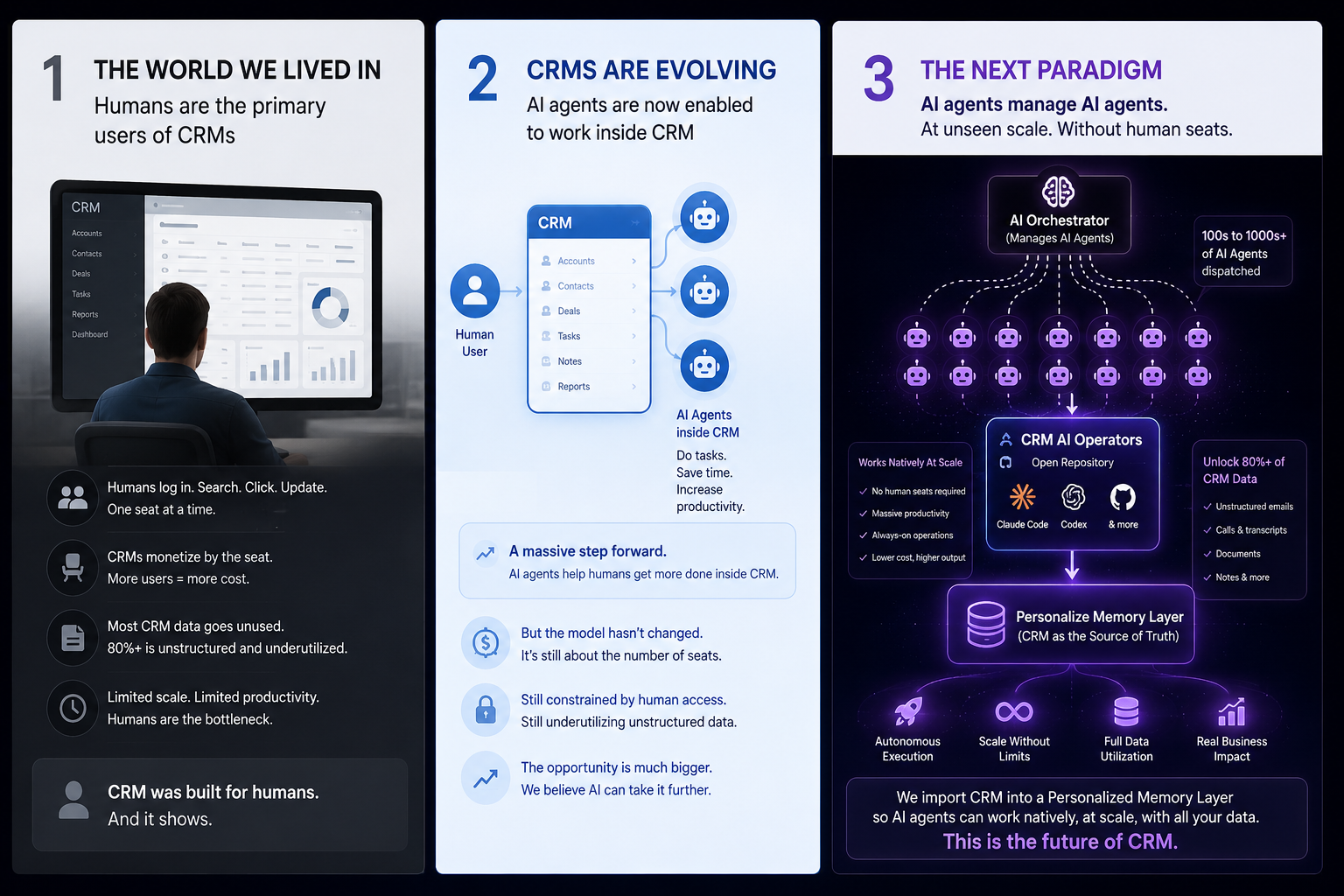
Architecture 1: human operators. Five reps, forty-hour weeks, two hundred hours of capacity. The ceiling is headcount times hours, and it has been the ceiling forever.
Architecture 2: human plus agent. This is where most good teams sit today. A rep asks an agent to draft ten follow-ups, research a prospect, and update fields across a segment, and never touches the UI to do it. That rep is meaningfully more productive: call it five hundred effective hours from the same five people. But the human still reviews, still approves, still gates every output. The interface changed. The ceiling didn't.
Architecture 3: agent plus agent. Remove the gate. Five people direct fully autonomous agents that listen to thousands of hours of calls, read across tens of thousands of records, qualify and score accounts, surface signals, and build outreach sequences, without waiting for a human to bless each step. Now the ceiling isn't headcount. It's compute and data access, and the same five people can direct the equivalent of thousands of hours of work a week.
That last paragraph is easy to write and easy to wave away as a slide. So let me make it concrete, because the concrete version is the whole argument.
What Architecture 3 looks like on a Tuesday
Picture Maya, who runs RevOps for a 200-person software company.
A year ago her week was triage. Which accounts got attention was mostly a function of which records somebody happened to open; the other ninety percent of the pipeline sat dark. Most of her own time went to data entry, list hygiene, and the kind of "personalization" that ends up templated because nobody has the hours to do it for real.
Now she walks in Monday and the work has already happened. Overnight, every contact in the base (not the forty a rep got around to, all eight thousand) was scored against the ICP, because the scoring agent doesn't get tired and doesn't run out of Mondays. Every AE with a meeting today has a brief waiting: what this account has said across every call and email, what changed since last contact, what to lead with. Nobody assigned those briefs. Every customer who churned in the last year was revisited this month; everything they ever sent or said was re-read and re-scored against current signals, and three of them just tripped a budget-availability trigger that a human would never have caught, because no human was reading.
Maya's job is no longer to do any of that. It's to decide what the agents optimize for. She spends Tuesday morning on a question she never had time for when she was doing data entry: the win-back sequence is converting at half the rate of net-new outreach. Is that a targeting problem or a messaging problem, and what should the agents test next? That is the work that was always supposed to be hers. For years the tooling forced her to spend it on hygiene instead.
This is what changes when the agent is the user. None of it was reachable at scale before, and not because the intelligence wasn't good enough. The bottleneck was never intelligence. It was the architecture underneath, which was built for a completely different reader.
Why it doesn't exist yet
Point a capable agent at your CRM today and tell it to work the pipeline. At ten records it looks like magic. At ten thousand it comes apart, and it comes apart for a reason that starts in the database itself.
Every major CRM runs on a relational schema built for one kind of reader: a query planner returning exact rows for exact filters. Reports. Dashboards. Human eyes. An agent reads nothing like that. It doesn't ask for "contacts where stage = negotiation and last_activity > 30 days." It asks, in effect, what do I need to know about this customer to write a renewal email they'll actually answer. That question has no SQL equivalent. It needs structured fields, free-form notes, email threads, and call transcripts fused into one picture inside a tight token budget; the schema files the transcripts as text blobs it can store but cannot reason over. The insight that a prospect mentioned budget pressure on a call three months ago doesn't live in a column. It lives in a recording the CRM filed and forgot.
Four things break as a result, and each one is a reason pilots die in the demo.
Memory. The agent doesn't remember what it learned last week, so it re-reads the same emails and reaches the same conclusions on every run. Without a memory layer separate from the CRM, the work evaporates between sessions, and the token bill climbs each time the agent re-learns what it already knew. In my own testing, running open-ended agents on raw records this way costs roughly an order of magnitude more than running memory-grounded operations on the same records. Memory isn't a convenience. It's the cost control.
Sharing. A scoring agent, a research agent, and an outreach agent run on the same contact and pull three different slices of it, because relational retrieval is driven by the query, not by what the task needs. None of them write their learning back in a form the others can use. Every agent starts from raw.
Governance. There are no rules about what the agent may write, to which fields, under what conditions. One ambiguous prompt and it overwrites a contact record with garbage. No revenue leader will greenlight a system that can do that with no audit trail, which is the single most common reason AI-in-CRM pilots never leave the demo.
Auditability. When something lands wrong, nobody can answer what the agent wrote, when, or why. That isn't a compliance footnote. It's the reason sales leaders don't trust agent-generated updates in the first place.
Underneath all four sits a quieter problem: more data is not better. Output quality saturates around a handful of well-chosen, task-relevant signals per record. Dump the full record into the context (every empty field, every audit timestamp, every UI status code) and you spend tokens making the answer worse. The constraint was never how much the CRM holds. It's curation. A schema built for human-readable reports is not built to deliver the most signal per token to an agent.
The two unlocks
So here is the claim the vendor announcements don't make, and the reason access alone won't carry you to Architecture 3. The move isn't a product decision. It's two engineering ones.
Build a memory layer, so agents accumulate intelligence between runs instead of starting from scratch each time. This is also what inverts the economics: the more an agent has already processed, the cheaper every later run becomes.
Build governance, so a revenue leader will trust what the agents write without reading every line. Clear rules for what they can touch and under what conditions, with a full audit trail when they do.
Solve those two and the difference stops being incremental. A better demo becomes a different operating model. That is the line between Architecture 2 and Architecture 3, and it's drawn in infrastructure, not intelligence.
A reference implementation
This is the gap I built an open-source library to close. crm-ai-operators is a set of 26 CRM operations that teach an agent to work inside a CRM at scale without a human in the approval loop. The shape is simple: your agent (Claude Code, Codex, any MCP client) calls the operations; the operations run on Personize, which handles memory, governance, and audit logging; Personize talks to your CRM, whether that's HubSpot, Salesforce, or any CRM via adapter.
Wiring it into Claude Code is two server blocks in your settings file. Every operation is dry-run by default. Writes only ever land in namespaced fields, never on top of your existing data, and every read and write is logged with agent ID, timestamp, and a diff. The operations span seven things a revenue team actually needs an agent to do on a record: scoring, research, generation, analysis, action, reporting, and optimization.
Where it stops being a demo is scheduling. One script, run once each morning: pull the enterprise leads with no qualification yet, fan out one scored sub-agent per record, jitter the runs across the hour, and write results back before the first rep arrives. Each sub-agent recalls what it already knows about the lead, scores it against your ICP, and writes to HubSpot or Salesforce. Maya walks in to updated scores. Nothing was reviewed by hand. Everything is auditable. (The dispatch script and full config are in the repo.)
The economics
The cost case isn't magic; it's memory. Without it, an agent re-runs the same searches and re-reads the same content every single time: token cost scales with everything the agent doesn't know. Memory inverts that. In the deployments I've worked on, one agent running a handful of these operations offsets two to three RevOps hours a day of scoring, enrichment, research, and hygiene. At scale, teams have offset the equivalent of five to ten full-time roles across sales ops, marketing ops, and AE support, while improving data quality instead of adding to the CRM debt.
Personalization has always converted. The only thing that ever held it back was scale, and that constraint is now removable.
Where you actually are
Most revenue teams today sit between Architecture 1 and Architecture 2: logging in less, approving more, getting some hours back. That's real, and it isn't the thing. The CRM is becoming infrastructure and the agent is becoming its user; Salesforce and HubSpot built the door. Whether you walk through it comes down to the two problems they left for you: a memory layer so your agents get smarter between runs, and governance so you'll trust them without watching every keystroke. Build those, and scale stops being a ceiling and starts being a dial.
The repo is open source and on GitHub, and it's written to be read by an agent: point Claude Code, Codex, or Gemini at it and ask it to assess the design. To connect a CRM, sign in at app.personize.ai and aim your agent at the repo; everything is dry-run by default, so nothing writes until you say so. If you want to talk through a use case first, email me. The ones early users raise are the ones shaping the next version.