Personalized outbound is easy to demo and hard to trust. One generated page for one hand-picked account looks magical. Run the same engine across tens of thousands of records and the property that decides whether the program lives or dies is not how impressive the best output is. It is whether the average output is useful enough to earn an action, and how rarely it says something confidently wrong about the reader's own business.
Those two are the same problem. Personalization is only worth doing if it creates value, and a buyer acts when the content is specific, true, and genuinely useful to them. The moment it is confidently wrong, "you clearly don't know us," the value goes negative and takes the sender's credibility with it. So accuracy is not the goal. Accuracy is the floor. Usefulness is the goal, and you cannot be useful and wrong at the same time.
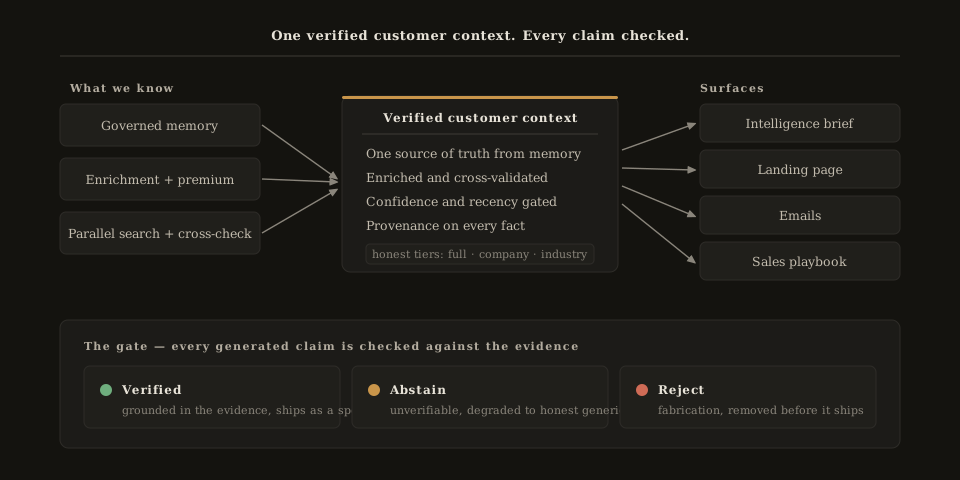
Reaching that bar at scale is not a matter of a better prompt. It is an architecture, one where governed memory, enrichment, task decomposition, deterministic guardrails, and honest degradation each carry part of the load and reinforce each other. This is that architecture, and why each part is there.
It starts with governed memory as the source of truth
Accuracy begins before a single word is generated, with one canonical, governed view of what we know about a person and a company. In our platform that view lives in governed memory: a single, permissioned source of truth that every surface reads from, rather than a scatter of fields each generation re-interprets on its own.
That word, governed, is doing real work. It means every fact has a known origin and an access rule attached to it, so the system can always answer where a piece of information came from and whether it is allowed to be used in a given place. And because the brief, the landing page, and the emails all reason from the same governed view, they cannot quietly contradict each other. An enterprise reader notices that consistency immediately, and notices its absence even faster.
Memory is paired with guidelines, and the division of labor is deliberate. Memory is what is true about the account. Guidelines are how to use it: the voice, the claims that may and may not be made, the shape of a strong output, the priorities for this campaign. Memory grounds the content in fact; guidelines shape it into something an expert would have written. Facts without guidance read like a database dump. Guidance without facts is exactly where fabrication lives. You need both, governed together.
Enrich the context, and cross-validate what you already know
What we hold in memory is rarely complete, and never guaranteed current. So we enrich: premium data sources for firmographics and people, and several searches run in parallel to gather recent, public signal. Enrichment does two jobs, and the second is the one most teams skip.
The first job is to add context we lack. The second is to cross-validate context we already have. A fact held by a single source is a hypothesis; the same fact corroborated by an independent source is something you can put in front of a customer. Running searches in parallel and reconciling them against governed memory is how a stale title, a misattributed company, or a two-year-old event gets caught before it reaches the copy, rather than after a prospect points it out.
Two disciplines sit inside this step and matter more than they sound. The first is entity resolution: the same company and the same person show up across sources under slightly different names and forms, and we resolve them to one identity with a confidence score, so we never personalize to the wrong individual or the wrong employer. The second is recency: information whose age we cannot establish is not treated as current, because "recent" is itself a claim, and an out-of-date signal presented as fresh is one of the fastest ways to look automated.
Break one large task into specialized zones
A landing page or a sales playbook is not a single generation, and treating it like one turns quality into a coin flip. We decompose the work into personalization zones: small, well-scoped pieces, a hero line, an industry section, a signal card, a call opener, each with its own specialized guideline, an expert brief for that one job. A dedicated subagent owns each zone.
The reason is accuracy, not tidiness. A tightly scoped task with a focused guideline is far easier to get right, and to keep right, than one sprawling prompt asked to do everything at once. Narrow scope gives the model fewer ways to wander, lets the guideline be precise about exactly this output, and, most importantly, makes each zone something we can measure and improve on its own. Personalization at enterprise quality is an assembly of many small, expert judgments, not one heroic generation.
Optimize each subagent across many records, not one
A zone is not finished when it produces one good example. A cherry-picked win tells you the ceiling; at scale you live on the floor. So we run each subagent across a spread of real records and tune its instruction and guideline until the output is consistently accurate and expert-grade across all of them, not just impressive on the demo account.
The spread is the point. The odd company whose name collides with a product, the account with thin public data, the one in an industry the guideline did not anticipate, these are where a clever prompt quietly breaks, and where a well-optimized one holds. Tuning against that spread, record after record, is what turns a promising zone into a dependable one, and dependability across the long tail is the entire game in enterprise personalization.
Wrap the model in deterministic guardrails, before and after
Language models are probabilistic. The guardrails around them are not, and that is deliberate. We bracket every generation with code that enforces the rules on both sides, so correctness never rests on the model happening to behave.
Before generation, the system decides what the model is even allowed to be specific about. Only verified facts from governed memory and cross-validated enrichment are placed in front of it; when the evidence is thin, the instructions shift to keep the copy honestly general; and when there is too little to say anything specific safely, the system declines to generate a specific claim at all rather than inviting one. The model is handed a bounded, trustworthy context, never an open field.
After generation, a deterministic harness checks the output by extraction and matching, not by trust. It pulls the concrete claims out of the generated text, every named product, number, date, and event, and tests each one against the verified context and the campaign's rules: no claim that the reader is already a customer, no unverified figure, no banned or internal-only vocabulary, no leaked recipient name, nothing malformed. When a section fails a check, the harness replaces that whole section with a true, general fallback that carries no unverified specific. We replace whole sections rather than editing phrases in place, because surgical edits to generated prose wreck its grammar, a lesson learned the direct way. This is the step where "the model probably got it right" becomes "we checked, and it did."
Because every fact carries its provenance from governed memory, the harness can do something a bare model never could: it can tell not just whether a claim is plausible, but whether it is sourced, and whether that source was permitted here. Accuracy and governance turn out to be the same discipline seen from two sides.
Let each subagent review its own work
Before the deterministic harness ever runs, the subagent checks itself. Every zone's instruction ends with an explicit review step: re-read what you just wrote, test each specific claim against the context, and fix anything that does not hold before returning.
# Final step, before you return your output.
Re-read every sentence you just wrote. For each specific claim
(a named product, a number, a date, a named event):
  - confirm it appears in the CONTEXT above; if it does not, remove it.
  - if removing it leaves a gap, replace it with a statement that is
    true and general, never one that sounds specific but is unverified.
Re-check the guideline's voice and rules once more, then return.
The self-review and the deterministic harness are not redundant, they are two layers of a defense. The review is soft and cheap and improves the writing in the same motion the model is already in; the harness is the hard backstop that does not depend on the model being honest about itself. The soft layer catches most of it early. The hard layer has the final say.
When the evidence is thin, say less, on purpose
The counterpart to "never fabricate" is "abstain gracefully." When the verified context is thin, the content drops to a lower tier of specificity by design, and stays useful by being honestly general instead of falsely precise.
| Tier | What we can stand behind | What the copy does |
|---|---|---|
| Full | Trusted identity, corroborated company facts, a recent verified signal. | Speaks to the specifics: the real event, the role, the named detail. |
| Company-level | Solid company facts, but the person or the recency is uncertain. | Talks about the company and its situation. No claims about the individual, nothing framed as "recent" without a date. |
| Industry-level | Little we can verify for this specific account. | Draws on what is genuinely true for companies like this one, and makes no claim it cannot support. |
The tier is chosen by the evidence, never by ambition, and the copy never fabricates to climb one. A well-written industry-level message is a success. A specific-sounding message built on an invented detail is a failure even when it reads better, because it fails the only test that matters.
The architecture is source-agnostic, so it grows with the relationship
Everything so far draws context from governed memory and enrichment. For an existing account, though, the richest context is neither, it is the customer's own first-party data, and the architecture is built to take it. Because the pipeline treats every input as evidence, cross-validated, recency-bounded, and provenance-tracked, it extends cleanly to whatever a client can share and wants incorporated: CRM fields and notes, call transcripts, support tickets, invoices and billing history, product usage.
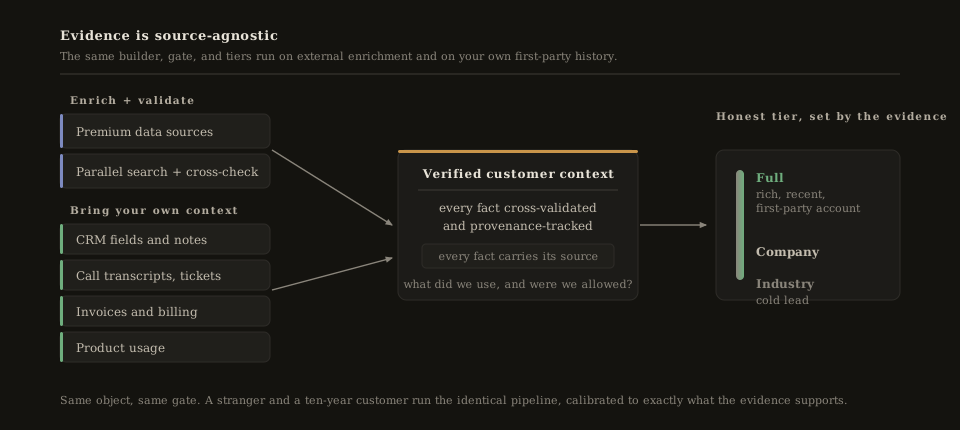
This is where personalization stops being outbound decoration and becomes account intelligence. A stranger and a ten-year customer run the identical pipeline, and the difference in the output is entirely a function of how much true, recent, cross-validated context exists about each, which is exactly as it should be. It is also where governed memory earns its keep a second time: because every fact carries its provenance and its access rule, the system can always answer what did we use, and were we allowed to use it here, and keep a confidential fact off a surface it does not belong on. That property is what lets an enterprise turn its most sensitive internal data into better customer experiences without losing control of it.
The bar is usefulness, judged the way an expert would
Underneath all of it is a single evaluation standard. We do not grade an output by how personalized it looks. We grade it the way an expert practitioner grades their own work: is the reasoning sound, is every claim true, and is the result useful enough that the recipient actually acts on it? Reasoning quality and output quality, from an expert's perspective, are the metric, because they are what create value, and value is what drives the action the whole exercise exists to produce.
That standard is the thread that ties the architecture together. Governed memory and cross-validated enrichment make the facts trustworthy. Zone decomposition and per-record optimization make the quality consistent. Self-review and the deterministic harness make sure nothing untrue survives. Honest tiers keep the content useful when the evidence runs thin. And the whole thing is judged not by how clever it sounds, but by whether an expert would put their name on it, and whether the customer is glad they received it.
The framework, distilled
- Govern the source of truth. One permissioned, provenance-carrying view of the customer, read by every surface, so nothing contradicts anything else.
- Enrich and cross-validate. Premium sources and parallel search to add context and, just as importantly, to corroborate what you already believe. One source is a hypothesis.
- Resolve identity and bound recency. Match every source to one person and one company with a confidence score, and never present information of unknown age as current.
- Decompose into specialized zones. Small, well-scoped tasks, each with its own expert guideline and subagent. Scope is what makes accuracy achievable.
- Optimize each subagent across many records. Tune against a spread of real cases until the output is consistently expert-grade, especially on the long tail.
- Guardrail the model on both sides. Bound what it may claim before generation; extract and check every claim after, and replace whole sections that do not hold with a true, general fallback.
- Review inside every subagent. A soft self-check that fixes issues early, backed by the hard harness that has the final say.
- Degrade honestly. When the evidence is thin, say less and stay true. Never fabricate to sound informed.
- Grow with the relationship. A source-agnostic pipeline that folds in first-party context, CRM, transcripts, tickets, invoices, usage, as cross-validated, governed evidence.
- Judge by usefulness, from an expert's perspective. Reasoning and output quality are the metric, because value is what earns the action.
Specific and true, or honestly general. Never fake-specific, never false. Build personalization on governed memory and hold it to that line at scale, and it stops being a gimmick and becomes the reason an enterprise customer pays attention, and keeps paying attention, because the system has earned their trust one accurate, useful message at a time.