AI agents now work for hours and make dozens of retrievals per task. As each customer gets worked by tens to hundreds of agents a month, the cost of letting them know your customers scales exponentially — unless a memory layer sits between the agents and your CRM.
TL;DR
- The unit of revenue work is shifting from "a salesperson handles 200–300 leads a month" to "tens-to-hundreds of agents work every customer, every month." Each agent must know the customer to reason well, so each one retrieves.
- Agents are working longer and taking more steps. METR finds the task length AI can complete autonomously has doubled every ~7 months for six years (recently ~4); Claude went from 7 hours of autonomous work to 30+ in a single year.
- A single agent task is already a lot of retrievals: ~25–29 tool calls for a coding task, 50–100+ sources for one deep-research query. Bots now make up the majority of web traffic, and Gartner expects agents to drive >30% of all API-demand growth.
- So "ten retrievals per record" is not high. It's the floor — less than one deep task — on a curve heading toward hundreds.
- At that scale, raw LLM cost grows exponentially and kills the project (Gartner: >40% of agentic-AI initiatives canceled by 2027, led by cost). A memory layer that compacts customer data ~85% and serves it for a flat fee turns that exponential curve into a flat line — about 20× cheaper — and the same deep understanding powers personalization that drives revenue.
The ceiling just disappeared
For thirty years, the throughput of a revenue team was bounded by people. A good salesperson can research, prepare, and act on 200–300 leads a month — reading the CRM record, the email history, the call notes, the company's site and recent news, then deciding what to do. Multiply by headcount and you have your capacity. To do more, you hired more.
AI agents remove that ceiling. You can now point tens — soon hundreds — of agents at every customer, every month, each answering a different question: Is this account qualified? What's our history with them? What do we actually know about their business? What's the next best action? What risk do we infer? The work that gated a rep's week is becoming something a fleet does continuously, in parallel, around the clock.
But every one of those agents has to know the customer to reason accurately and decide well. And to know the customer, it has to fetch.That single requirement — every agent must retrieve what it can about the customer before it can think — is where the economics of the agent era are decided.
The world is moving to agents that work for hours
This isn't a forecast; it's a measured trend. METR, an independent evaluation lab, tracks the length of task (measured in how long it takes a human professional) that frontier agents can complete autonomously at 50% reliability. Their finding has the shape of a Moore's Law: that horizon has doubled roughly every seven months for six years — and analyses of post-2023 models put the recent doubling time closer to four months. By May 2026, the frontier sits around a 16-hour task horizon; METR notes its own task suite can no longer reliably measure beyond that. Extrapolate two to four years and you get autonomous agents handling week-long projects.
The vendors' own numbers track the curve. Anthropic's Claude Opus 4 could work autonomously for about 7 hours; months later, Claude Sonnet 4.5 sustained focus for 30+ hours, building a complete application and ~11,000 lines of code in a single unattended run.
Longer runs mean more steps. And more steps mean more retrieval.
Every step is a retrieval — and one task is a lot of them
Here is the question that started this piece: is ten retrievals per customer a lot, or a little? The honest answer requires looking at how many calls a single agent actually makes.
- Coding agents. On SWE-bench Verified, agents resolve a task in roughly 25–29 tool calls on average (SWE-agent ~24.9; Claude 3.7 Sonnet ~29.1). The better systems deliberately read more files and plan before writing — i.e., they retrieve more, not less.
- Deep-research agents. A single deep-research query runs dozens of searches and reads hundreds of sources. OpenAI's Deep Research cites 50–100+ sources per query; Google's browses 100+ web pages; Perplexity runs dozens of searches through hundreds of sources in under three minutes.
- Multi-agent systems. Anthropic's research system spins up 3–5 sub-agents in parallel, each calling 3+ tools — and uses ~15× more tokens than a single chat. Tellingly, token volume alone explains ~80% of answer quality: more retrieval is how these systems get better.
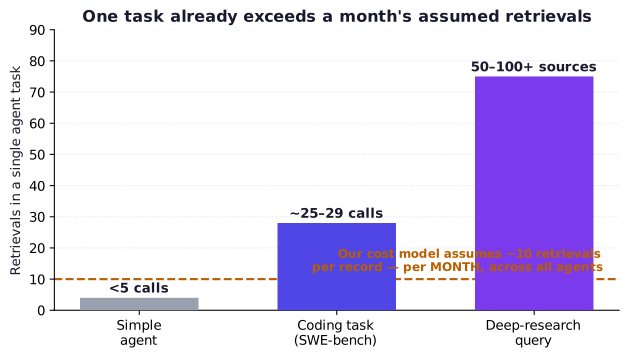
Now zoom out to the macro. Automated traffic has, for the first time, passed humans on the open web — Cloudflare Radar puts bots at 57.5% of HTML traffic versus 42.5% human — and HUMAN Security's 2026 benchmark clocked agentic AI traffic growing ~7,851% year over year. Gartner expects more than 30% of the growth in API demand to come from AI agents by 2026. ChatGPT alone fields 2.5 billion prompts a day, and Goldman Sachs models LLM queries reaching 11 billion a day by 2030, with token consumption multiplying 24× over the same window.
So: ten retrievals per record is not high. It's less than a single deep-research task — and our cost models count it per record, per month, across every agent. Ten is the floor on a curve heading toward hundreds.The right planning question isn't "is ten a lot?" It's "what happens to my bill when it becomes a hundred, then a thousand?"
Why this breaks the budget
Stack the multipliers. A rich B2B account carries 50,000–100,000 tokens of context a year — CRM fields, email threads, meeting transcripts, notes, tickets, web research. Read cold, every agent that touches that account re-reads a large slice of it. Multiply context-per-customer × retrievals-per-customer × number-of-customers × number-of-agents and the cost doesn't scale linearly with value — it scales with activity, which is now exploding on every axis at once.
This is not a hypothetical failure mode. Gartner predicts over 40% of agentic-AI projects will be canceled by the end of 2027, and the number-one cause it cites is escalating cost — hidden compute ballooning 2–3× beyond estimates. The demos work. The production economics don't. An agent that re-reads raw context on every step is the textbook version of that hidden cost.
The fix: a memory layer between the agents and the CRM
The structural answer is to stop making every agent re-read raw data. Read each customer once, extract a compact, governed memory, and serve that memory back to every agent in the fewest tokens possible. That is the job of a memory layer — and at Personize it's the job we've built specifically for the place customer data actually lives: the CRM.
The compaction is real and it's corroborated well beyond us. Across memory research the consistent finding is 80–95% token reduction — Mem0 condenses ~26,000 tokens of history to ~1,800 (≈90% savings); Zep reports ~94.8%; others land 80–93%. Personize targets up to ~85% compaction — deliberately conservative against the field, and the difference between a fleet you can afford and one you can't.
The pricing makes the consequence concrete. Personize charges $0.003 per 1,000 tokens to memorize a record once, and $0.001 per agent recall — flat, whether the customer holds two pages or two hundred. Compare that to running raw context through a frontier model on every recall. At today's published rates — Claude Opus 4.8 $5/$25, Sonnet 4.6 $3/$15, GPT-5.5 $5/$30 per million tokens (in/out) — a single five-page recall with a short answer costs:
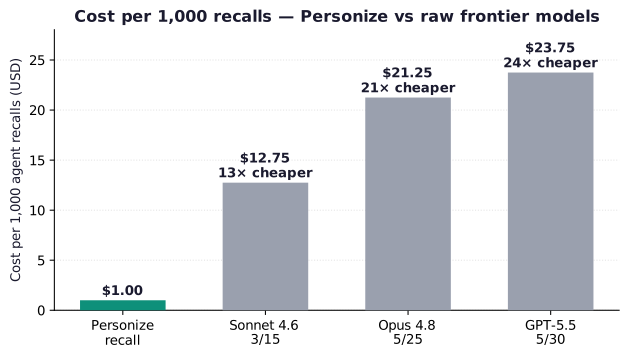
On Personize's own calculator the default workload returns up to ~23× more work per dollar — about 20× — with memorization saving ~65% versus naive LLM extraction and compact recall saving ~85% of the context tokens. We engineer the memorization side the same way: use the most cost-efficient models for extraction and recall, maximize prompt caching, and route bulk work through the Batch APIs offered by Bedrock, Anthropic, and OpenAI (a flat 50% discount) so companies can memorize as much as they need about every customer. The ~20× we model is the floor; our north star is 100–200× as the pipeline is optimized further.
The strategic point is not "cheaper." It's that a flat, compact cost converts the exponential curve that kills agentic projects into a predictable line item — so scaling the fleet becomes a decision, not a budget risk.But cost control is only half the story
The same deep, unified understanding of each customer that makes agents cheap also makes them effective — and that shows up as revenue and productivity, not just savings.
Revenue: mass personalization. Personize powers generative personalization — emails, landing pages, and sales playbooks tailored per customer, at the scale of thousands — because every agent shares one accurate memory of who the customer is. Personalization is among the most reliable revenue levers in the data: in our deployments and in reports on comparable products, it lifts conversion 2–10× (a 1% rate becomes up to ~10%; 0.1% becomes ~2%), and McKinsey independently puts the revenue lift from personalization done well at 10–15%. Rather than bank a multiple, a company can evaluate the technology against a conservative +10% revenue assumption — and find the memory investment is a small fraction of the upside.
Productivity: tens of employees on autopilot. Because Personize cuts the cost of knowing each customer ~20×, the same AI budget delivers far more agent activity. Sized against people: a rep handles ~250 leads a month, so processing 20,000 customers a month is the equivalent of roughly 80 salespeople's worth of research-and-prep — running continuously, in parallel. The team doesn't disappear; the ~70% of their week that Salesforce finds goes to non-selling work (research, admin, data entry) moves back to revenue. And the activity only pays off if the work finishes: unified memory is what lets long agent workflows complete instead of stalling when context runs out. Anthropic reports memory letting agents finish workflows that would otherwise fail (+39% on agentic search, −84% tokens), with Rakuten cutting feature-delivery time from 24 working days to 5 and agent error rate by 97% after adding managed-agent memory.
A worked example: a $50M ARR company
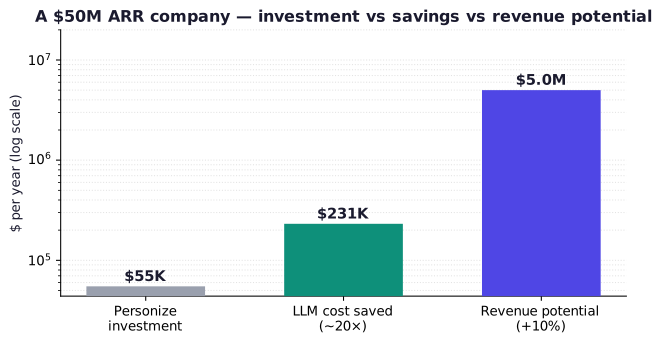
Make it concrete. Take a company with $50M ARR, 20,000 customer and prospect records, ~75,000 tokens of data per customer per year, and a conservative 30 agent-recalls per customer per month (squarely in the "tens of agents" range). Every figure below comes from the live pricing and the market averages cited above; change the inputs and the model scales linearly.
| Annual line | Impact ($50M ARR company) | Type |
|---|---|---|
| LLM cost saved — ~20× via 85% compaction | ~$231K (up to ~$486K at 100 recalls/mo) | hard saving |
| Avoided in-house build & ops (memory/CDP layer) | ~$1.1M+/yr equivalent | avoided cost |
| New-revenue potential — personalization +10% | ~$5.0M | upside |
| Productivity reclaimed — research/prep of ~80 reps | tens of FTE-equivalents | capacity |
| Personize investment | ~$30–80K / yr | ≈1–2% of the upside |
Two notes on rigor. First, building this in-house is not free: comparable customer-data-and-memory platforms run ~$1.1M+/yr in engineering headcount, $4–5M over three years, and 8–12 months before they work — a documented ~5:1 gap versus buying. Second, scaling agents requires trust: ungoverned agents create real liability (an airline was held liable for a chatbot's invented discount; a dealership's bot was talked into "selling" a $76K SUV for $1), and poor data quality already costs the average organization $12.9M a year. A memory layer that injects governance before any write and audits every read keeps the deployment out of Gartner's 40% cancellation statistic.
Where this goes
The bottleneck of the agent era is quietly shifting. It used to be "can the model do the task?" It is becoming "can you afford to feed it?" Agents are working for hours, taking dozens-to-hundreds of steps, and every step needs the right customer data delivered fast and in the fewest tokens. Retrieval volume per customer is on an exponential — and the lever that decides whether the fleet is viable is the layer that sits between the agents and your CRM, compacting what they need to know.
Ten retrievals per record was never the high end. It was the starting line.
Frequently Asked Questions
Isn't ten retrievals per record per month obviously low? Yes — that's the point. A single deep-research task already makes 50–100+ retrievals, and a coding task ~25–29. Counted per record per month across an agent fleet, ten is the conservative floor. The honest planning range is tens today heading to hundreds, which is exactly why per-retrieval cost is the variable that matters.
Why does raw retrieval cost grow "exponentially"? Because it scales with activity, not value. Cost = context-per-customer × retrievals-per-customer × customers × agents. Every one of those terms is rising at once — more agents per customer, more steps per agent, longer autonomous runs — so naive cost compounds while the underlying customer base barely changes.
Is 85% compaction a Personize-specific claim? No. Token reduction of 80–95% is the consistent finding across the memory field (Mem0 ~90%, Zep ~94.8%, others 80–93%). Personize targets up to ~85% — conservative by design. It refers to the context delivered to the model (recall payload), not to deleting stored data.
How is ~20× cheaper calculated? Personize charges $0.001 per recall versus the cost of shipping a few thousand tokens of raw context through a frontier model (~$0.02+ per call at Opus/GPT-5.5 rates). On the public calculator the default workload returns up to ~23× more work per dollar; memorization adds caching and Batch-API (−50%) savings on top.
Does compaction hurt accuracy? The research suggests the opposite at the system level: extracting and compacting the right facts removes noise. Memory systems consistently report equal-or-better task accuracy at a fraction of the tokens, and Anthropic reports memory letting agents complete tasks that previously failed outright.