
AI startups are not just smaller software companies. They are early evidence of a different company shape.
One of the quietest but most important questions in AI is not whether models make individuals faster. It is whether they change the shape of the firm.
The early evidence says yes.
The a16z Charts piece pulled together research on recent YC batches that compared AI startups with non-AI startups. The finding was straightforward: AI startups start smaller, stay smaller, and appear less hierarchical. Stripe's solopreneur data points in the same direction from the other end of the market: more tiny businesses are crossing meaningful revenue thresholds, with an acceleration after 2023.
There are caveats everywhere. YC is not the economy. Stripe's view is not the whole company formation universe. "AI startup" is a fuzzy label. But the pattern is consistent enough to take seriously.
The first-order effect of AI is productivity. The second-order effect is company design.If a five-person company can do what used to take fifteen, the interesting question is not "how many jobs disappear?" It is "what replaces the coordination those ten people used to provide?"
That is where the agentic company becomes a systems problem.
Headcount was also memory
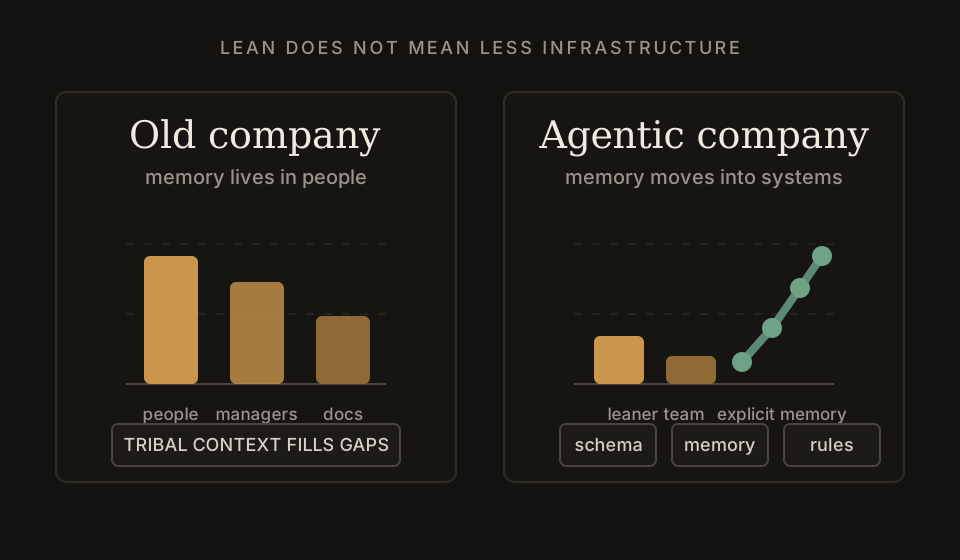
Companies do not hire only for labor. They hire for memory.
The account manager remembers what the customer hates. The implementation lead remembers which setup step always breaks. The support manager remembers which policy has an exception. The RevOps analyst remembers which revenue number finance trusts. The senior engineer remembers why the obvious architecture was rejected two years ago.
In a larger company, a lot of context is carried by people who are not visibly "doing the task" in the narrow sense. They are routing, interpreting, warning, checking, approving, and remembering. Hierarchy is not just control. It is a compression system for institutional memory.
When a company gets leaner, that memory does not become less necessary. It becomes more fragile.
This is the under-discussed side of AI-enabled startups. A small team with strong models can move fast because agents absorb work. But if the agents do not have persistent memory, governed context, and a shared model of the business, the company eventually hits a wall. Every task starts from scratch. Every agent rediscovers the same facts. Every founder becomes the human router for every exception.
Lean companies need stronger memory because they have fewer humans to carry it.
Flatter does not mean less coordination
The same applies to hierarchy.
If AI startups are less hierarchical, that does not mean coordination disappeared. It means coordination moved somewhere else.
In the old model, coordination often lived in managers: assign this, check that, remind this person, escalate that issue, translate leadership intent into team action, translate team reality back into leadership context. Some of that was bureaucracy. Some of it was genuinely load-bearing.
The lean agentic company has to replace that load-bearing part with systems.
Agents need to know the work to do. They need instructions. They need access to the right context. They need to call tools. They need to write back results. They need to hand off to other agents or humans. They need to know when to stop. They need to leave an audit trail. They need governance around what they are allowed to decide.
That is not "no management." It is management expressed as infrastructure.
The flatter the company, the more explicit the operating system has to be. Otherwise the missing hierarchy comes back as founder interruptions, Slack chaos, stale docs, and agents confidently acting on partial context.
The new middle layer
People often talk about AI replacing middle management as if middle management were one job. It is not. It is a bundle of functions.
Some of those functions are likely to shrink:
- status collection
- first-pass analysis
- routine assignment
- recurring reporting
- simple QA
- checklist enforcement
Some will become more important:
- deciding what the system should optimize
- defining what good work means
- setting governance boundaries
- resolving exceptions
- maintaining the ontology of the business
- inspecting whether agents are learning the right things
The lean agentic company does not eliminate the middle layer. It changes its substrate. Less of it is people moving information around. More of it is schemas, memory, instructions, workflows, evaluations, permissions, and review loops.
This is why I am skeptical of any "AI will make everyone a one-person company" story that stops at the model. A model can draft, code, summarize, search, and reason. But a company is not a pile of tasks. A company is a durable system for deciding which tasks matter, preserving what was learned, and making future work cheaper because past work happened.
That durability is the hard part.
What the lean company must build early
A ten-person AI-native company can postpone a lot of traditional process. It cannot postpone operating memory.
The earlier the team adopts agents, the earlier it needs answers to a few questions:
- Where does the agent store what it learned?
- Which entities does the company care about?
- What is the difference between a raw note, a typed property, and a durable fact?
- Which metrics and definitions are authoritative?
- What can an agent write without approval?
- What should trigger human review?
- How does a new agent inherit company context without reading the entire archive?
These sound like enterprise questions. They are becoming startup questions.
In the old company, many of those answers could live informally because there were enough people around to patch the gaps. In the lean company, the gaps show up immediately. A three-person team cannot afford to have every agent ask a founder what "qualified" means. A solo founder cannot personally inspect every automated follow-up. A five-person startup cannot rely on tribal knowledge if half the work is delegated to systems.
The operating layer has to exist earlier.
The solopreneur version
The solopreneur data is useful because it shows the same force in a purer form.
If more one-person businesses are crossing $100K, $1M, or higher revenue thresholds, the point is not that every person becomes a unicorn. The point is that coordination costs are falling. A single operator can now assemble more capability around themselves: writing, coding, support, analytics, design, research, outbound, operations.
But the successful solo operator still faces the same problem at smaller scale. If every tool is stateless, the founder becomes the memory bus. They copy context between systems, remind each assistant what matters, check for drift, and manually stitch outputs into a business process.
That works for a while. Then the founder is not limited by labor anymore. They are limited by coordination.
The next version of the solopreneur stack is not just better models. It is persistent context across tools, governed memory around customers and products, agents that can continue a task across sessions, and workflows that remember what happened last time.
The solo business and the enterprise agent fleet are different sizes of the same problem.
What investors and operators should watch
If AI really lets companies run leaner, the obvious metric is revenue per employee. It will matter, but it is not enough.
The deeper question is how much of the company's operating knowledge is explicit enough for agents to use. A small AI startup with brilliant people and no memory layer may look efficient until it has customers, exceptions, compliance needs, handoffs, and churn risk. Then every missing system becomes human load.
The stronger signal is not "they have fewer people." It is:
- repeated work gets cheaper over time
- new agents inherit context without long onboarding
- customer knowledge persists outside individual inboxes
- decisions are governed, not improvised
- workflows can be inspected and improved
- the company can add volume without adding proportional coordination
That is what lean should mean in the agent era.
Not thin. Not underbuilt. Not a team of exhausted generalists surrounded by chatbots.
Lean means the company has moved routine work and routine coordination into systems, while preserving the judgment, memory, and governance that make the work trustworthy.
The shape of the next firm
The next firm is smaller at the edge and heavier in the operating layer.
Fewer people may touch each task. More agents will. Fewer managers may collect status. More workflows will produce it automatically. Fewer humans may carry every customer detail in their heads. More of that detail will live as governed memory tied to entities. Fewer teams may pass work through long chains. More work will run in parallel at the record level.
That is the company shape the early startup data points toward.
The mistake is thinking "lean" means the infrastructure matters less. It means the opposite. When people are the bottleneck, you can patch process with headcount. When agents are doing the work, the process is the product.
The lean agentic company will not be the company with the fewest employees.
It will be the company where every employee, and every agent around them, works against the same durable memory of what the business knows.
For the workflow side of this argument, read AI-Native Is Not AI-Enabled. For the economics of running many agents over business records, read The Retrieval Explosion.