
The firms getting leverage from AI are not adding a model to the old process. They are rebuilding the process around the model.
The phrase "AI-enabled" has become almost useless. It can mean a chatbot in the corner of a product, a Copilot license on every laptop, a model call buried in a support workflow, or a company whose operating system was rebuilt around machine work. Those are not the same thing.
The useful distinction is simpler: AI-enabled means the old workflow got a model. AI-native means the workflow changed because the model exists.
That distinction explains a lot of the confusion around AI ROI. A company can spend heavily on AI, have thousands of employees using it, and still see little firm-level impact if the work underneath is unchanged. The model accelerates a task, but the business keeps the same handoffs, approvals, queues, dashboards, rework loops, and management habits. The tool is new. The production function is old.
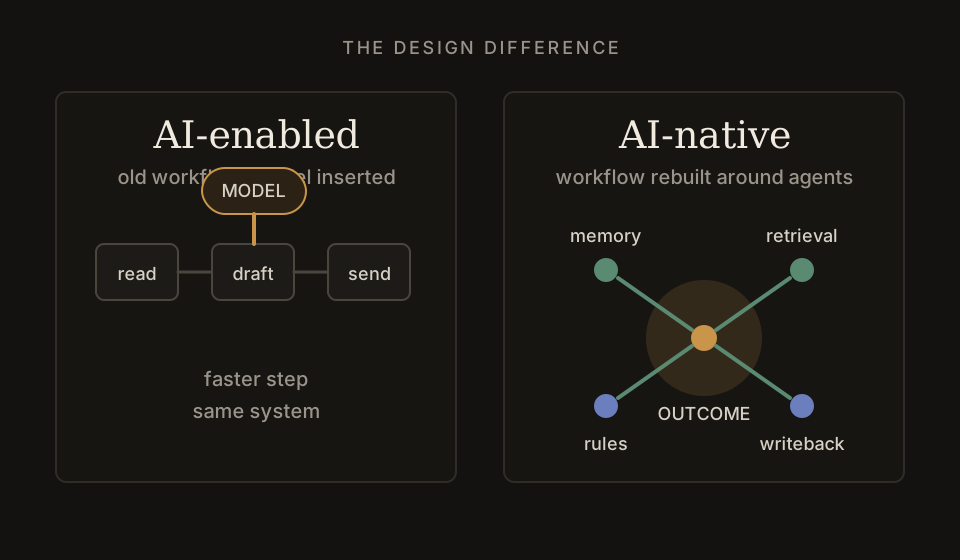
The charts that matter are not adoption charts. They are workflow charts.
In the a16z Charts piece that prompted this, the most interesting section was not the market-cycle rotation or even the robotics boom. It was the research on high-growth startups. The study separated firms that merely adopted AI from firms that learned how other companies reorganized production around AI. The second group did something different. They did not ask "which existing step can AI speed up?" They started further upstream, at the business outcome, and remapped the work around what AI made possible.
The reported differences were large: more AI use cases, more revenue at the top of the distribution, and less capital consumed. Read the exact numbers with the usual caution. One study is not a law of nature. But the direction matches what every serious deployment teaches the hard way: the value is not in using AI. The value is in discovering where the workflow should no longer look the way it did.
The bolt-on version
The bolt-on version is the default because it is the easiest to buy.
A team has an existing process. A human reads an inbound email, opens the CRM, checks account history, writes a note, drafts a reply, asks a manager for approval, sends the message, updates the opportunity, and sets a reminder. The AI project begins by asking which of those steps a model can help with. Maybe it drafts the reply. Maybe it summarizes the account. Maybe it writes the CRM note.
That can help. I am not arguing against it. A good assistant on a painful step is worth having.
But the process still has the same shape. The human is still the scheduler, memory, router, checker, and integration layer. AI is sitting inside the workflow as a faster pen. The company gets local productivity and calls it transformation.
This is where many enterprise pilots get stuck. The organization measures usage, not redesign. The vendor reports seats activated. The team reports prompts run. Leadership asks where the margin improvement is. Everyone is telling the truth, and the business still did not change.
The native version
The native version starts with a different question.
Not "where can AI help this process?" but "what should this process be if agents can read context, remember what happened, call tools, follow instructions, and work in parallel?"
That question moves the design upstream. The sales workflow is no longer a human asking an assistant to summarize an account. It becomes an agent that monitors account changes, keeps a governed memory of the relationship, flags what changed since the last touch, drafts the next action, and escalates only the parts that need human judgment. The human is no longer the integration layer. The human becomes the decider, reviewer, exception handler, and owner of the relationship.
The support workflow is no longer a rep asking for an answer. It becomes a triage system that classifies the issue, retrieves the relevant policy, checks the customer's history, drafts the response, updates the case, and learns from the final resolution. The new rep is not starting from zero because the agent is carrying the organization's memory into the moment of work.
The analyst workflow is no longer text-to-SQL over a raw warehouse. It becomes a semantic and ontological layer the agent can trust: certified metrics, entity definitions, relationships, freshness, authority, and the company's own meaning. The agent does not need more tables. It needs to know which facts matter.
That is why so many of my recent pieces circle the same infrastructure: memory, retrieval sessions, ontology, governed writes, instructions instead of prompts, subagents dispatched against records. They are not separate features. They are what has to exist before the workflow can change.
The mapping problem
The study's phrase for this was the "mapping" problem, and it is the right word.
Every company has a hidden map of how work actually gets done. Some of it lives in systems. More of it lives in people's heads: which customer matters, which policy has exceptions, which metric finance trusts, which manager will reverse an answer, which Slack thread contains the real history. AI does not automatically inherit that map. A general model knows language and patterns. It does not know your operating reality.
So the first bottleneck is not generation. It is mapping.
Which entities does this work touch? Which facts need to persist between runs? Which fields are authoritative? Which relationships matter? Which decision belongs to the agent and which belongs to a human? What counts as success? What should be written back? What should be forbidden? What should be remembered?
This is why "just connect the model to the database" keeps failing in subtler ways than people expect. The database knows rows. The workflow needs meaning. The CRM knows fields. The agent needs a model of the customer, the company, the relationship, the process, and the rules. The document store knows chunks. The agent needs the policy that is currently in force and the exception that applies to this account.
An AI-native company is not a company with more prompts. It is a company that did the mapping work.
The old analogy is still the best one
Electrification is overused as an AI analogy because it is useful.
Early factories did not get the full productivity gain by swapping a steam engine for one large electric motor while keeping the old line shafts and belts. The big gains arrived when factories were redesigned around distributed power: smaller motors at individual machines, new layouts, new flows, new assumptions about what could be done where.
AI has the same trap. The first instinct is to replace the old motor. Keep the same workflow, same handoffs, same approval chain, same dashboard, but now with a model powering one step. That is AI-enabled.
AI-native is distributed intelligence inside the work. Agents at the record level. Memory at the entity level. Retrieval that continues across a long task. Instructions that define the workflow, not one-off prompts that decorate it. Governance that says what the system can trust and what it can write. Measurement attached to outcomes instead of activity.
You do not get there by buying a license. You get there by changing the architecture of work.
A quick test
Here is the simplest test I know.
Ask of any AI project: if the model were removed tomorrow, would the workflow still basically make sense?
If yes, you probably built an AI-enabled version of an old process. It may still be useful. It may save time. But the structure did not change.
If no, you may be closer to AI-native. The workflow now depends on capabilities the old process did not have: parallel work, persistent memory, automated retrieval, entity-aware context, agent-to-agent handoff, governed writes, continuous learning from outcomes. Remove the model and the process collapses because it was designed around machine work from the start.
That second category is where the firm-level gains should show up.
Where to start
The practical move is not to declare a company-wide transformation. It is to pick one workflow where the old process is mostly coordination, context gathering, and repeated judgment.
Do not start by asking which model to use. Start by drawing the workflow as it really happens. Then mark:
- what context the human has to gather every time
- what facts should persist after the task is done
- what decisions are repeatable
- what exceptions need a human
- what the agent should be allowed to write back
- what outcome will prove the workflow improved
That map becomes the system design. Memory stores what should compound. Retrieval brings back only what is needed. The ontology tells the agent what the business means. Instructions define the operating loop. Governance decides where autonomy ends.
The companies that win with AI will not be the ones with the highest model usage. They will be the ones that do this mapping faster and more honestly than their competitors.
AI-enabled is a feature.
AI-native is an operating model.
This is the strategy version of the argument. The implementation version is in Where to Start With Agents, and the data-infrastructure version is in Agents Don't Need Your Database. They Need Your Ontology.