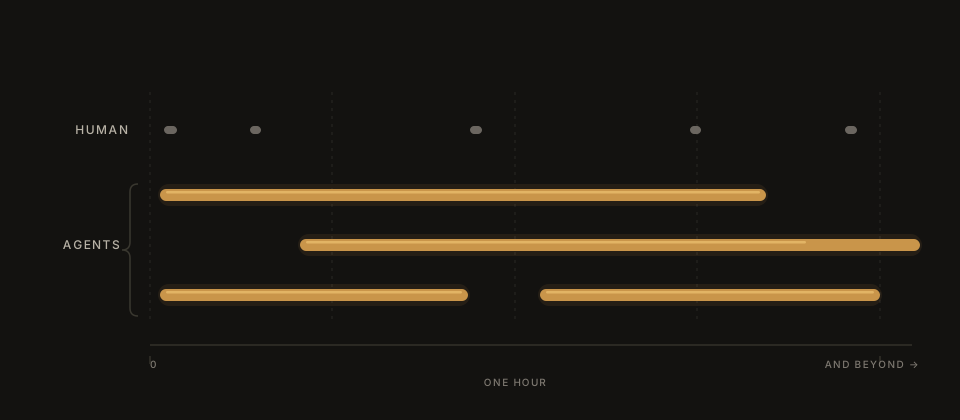
The unit of knowledge work just changed from a chat turn to a delegated task. The data says it's happening fast, the gains are real, and the time to get in is now.
For two years the mental model for AI at work was a chat box: you ask, it answers, you do the work. That model is already obsolete, and the numbers behind the shift are striking enough to change how you plan the next year.
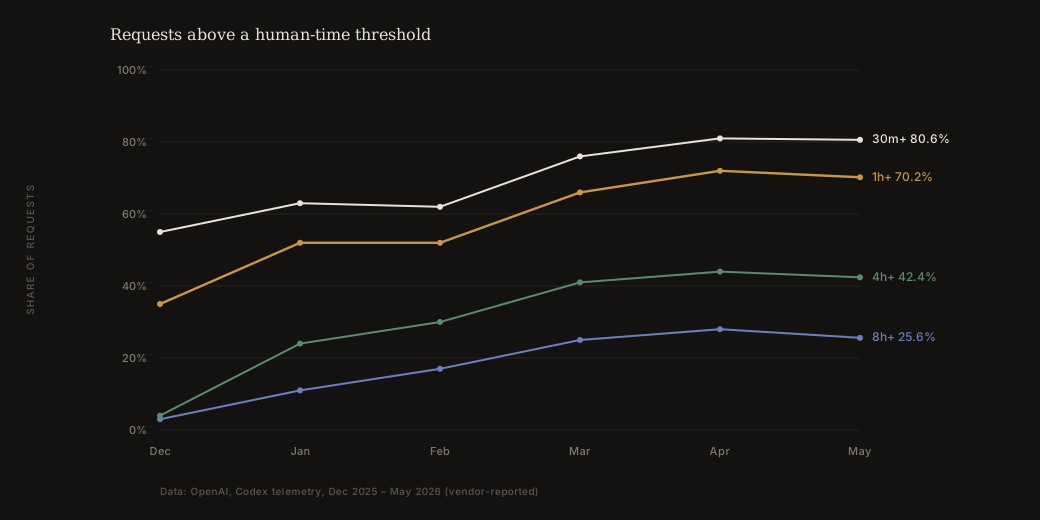
Start with what OpenAI just reported. This is their own usage telemetry, so read it as direction rather than independent proof, but the direction is unmistakable. Non-developer individual users of their agent products multiplied roughly 137 times since August 2025. Nearly a quarter of all Codex requests are now for tasks that would take a person more than an hour. Between December 2025 and May 2026, the share of requests corresponding to more than thirty minutes of human work climbed to 80.6 percent. At the very top, heavy users run more than sixty hours of agent work per day, spread across parallel agents that keep going while the human does something else.
The unit of knowledge work shifted from a single interaction to a delegated, long-horizon task. That is the whole story in one sentence. An agent that runs for an hour, calls tools, checks its own work, and comes back with a result is a different kind of coworker than a chatbot that answers a question. And it is not confined to engineers: in OpenAI's data, legal, finance, and recruiting crossed over to majority agent use within months of starting.
The productivity is real, and it's measured
Vendor enthusiasm is cheap. What makes this moment different is that independent studies, not press releases, now show the gains.
In a study of 5,172 customer-support agents at a Fortune 500 company, access to an AI assistant raised issues resolved per hour by about 15 percent, and by 34 percent for the least experienced agents. A randomized trial across Microsoft, Accenture, and a Fortune 100 firm, pooling 4,867 developers, found a 26 percent increase in completed tasks. Anthropic's Economic Index shows the texture of how people actually use these tools: augmentation, where the human and AI collaborate, has overtaken pure automation, 52 percent to 45 percent. People aren't just handing work off. They're working alongside the agent and getting more done.
The pattern underneath those numbers is the exciting part: the largest gains go to the least experienced people. AI compresses the gap between a new hire and a veteran. For a team, that is leverage you could never buy before.
Where the hype breaks, so you don't get burned
Being early is an advantage only if you are clear-eyed, so here is the honest edge of the data. The same research that shows big gains for support reps and junior developers also found, in one careful trial of sixteen experienced open-source developers, that early-2025 AI tools made them about 19 percent slower. Not faster. Slower. The lesson is not "agents don't work." The lesson is that bolting an agent onto an expert's existing flow, on work they already do fluently, can cost more than it saves. The gains are real and they are uneven, and the difference is entirely in how you deploy.
That nuance is the line between excitement and disappointment. Treat agents as a magic speed-up for everyone and you will be let down. Aim them at the right work, the long-horizon and the high-volume and the junior-heavy, and the numbers above are yours to capture.
Why now
Put the pieces together. The capability crossed a threshold: agents now do hour-long tasks, in parallel, across every department, not just engineering. The productivity is independently measured, not promised. And adoption is compounding fast enough that waiting a year is a competitive decision, not a neutral one.
The honest forecast is bullish with a condition. Gartner expects a third of enterprise software to be agent-enabled by 2028 and fifteen percent of day-to-day decisions to be made autonomously, while also predicting that many early projects will be canceled along the way. Both can be true. The technology is arriving, and the organizations that learn to aim it will pull away from the ones that dabble.
So the real question stopped being whether agents change your work. They already are. The question is where you point them first. That is a choice you can make this week, and it's the subject of the companion piece.
If you want the practical on-ramp, Where to Start With Agents turns this into a first move you can make now. Subscribe for the next pieces on putting agents to work without joining the pile of stalled pilots.