Same company, same task, three different AI agents, three completely different answers. Your customers notice. Do you?
Here's what's actually happening inside most organizations right now.
Marketing built an AI agent on one platform. Sales built another using a different tool. Support has a third, connected to the CRM. Customer success is running a fourth through an automation workflow they set up themselves. Each team picked the tool that made sense for their use case. Each agent is connected to its own set of databases, documents, and APIs. Some of these agents feed into the same customer-facing processes. Some depend on each other's outputs. And none of them share a common understanding of what the company actually wants to say.
Now, picture what actually happens when each team runs its own automated workflow.
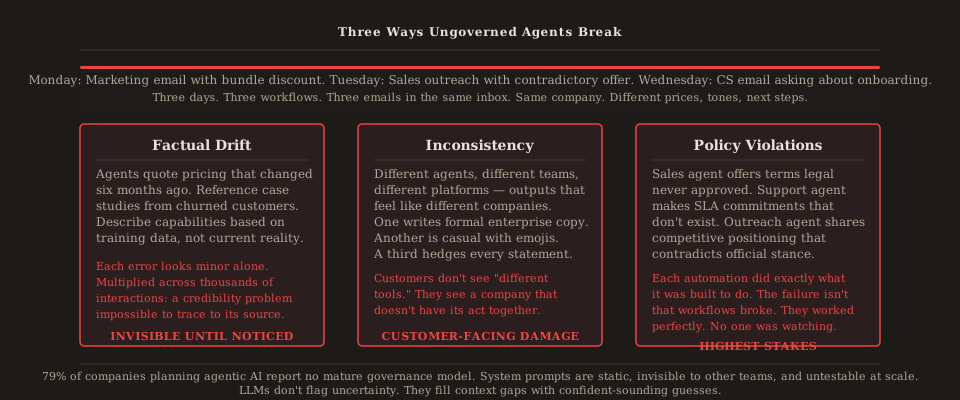
Marketing's promotional sequence fires on Monday: upbeat, emoji-friendly, built around a bundle discount that was live when the campaign manager set it up last month.
Sales' outreach runs Tuesday. The rep built a message around a LinkedIn post he read, full of technical jargon the customer doesn't care about, with an offer that contradicts marketing's.
On Wednesday, a customer success workflow triggers because the same account opened a support ticket three weeks ago. The CSM who built it joined two months ago and had no idea this account was already in active sales conversations. The email asks how onboarding is going and mentions a downgrade option "if the current plan feels like too much."
Three days. Three workflows. Three emails in the same inbox. Same company, same product, different prices, different tones, completely contradictory next steps.
Two people on the same sales team can build similar workflows but they produce opposite results: one built by a senior rep who knows the positioning, the other by a new hire who used a basic prompt and template. Same tool, same data.
Each automation did exactly what it was built to do, by whoever built it, with the data and judgment they had at the time. The failure isn't that the workflows broke. It's that they worked perfectly — and no one was watching.
This is the governance problem. And most teams don't realize they have it until a customer points it out for them.
Why This Keeps Happening
The speed of AI adoption is outpacing the infrastructure to manage it. Gartner predicts 40% of enterprise applications will embed task-specific AI agents by the end of 2026, up from less than 5% in 2025. But that growth is largely bottom-up: individual teams and employees adopting tools independently, solving their own problems, building their own workflows.
The result is an organization full of capable AI agents that have never been introduced to each other, and have never been told how the company actually operates.
This isn't a technology failure. It's an organizational design gap. Each agent is only as good as the context it was given, and right now, that context is whatever the person who set it up happened to copy-paste into a prompt. Your pricing strategy lives in one team's head. Your brand voice lives in a Google Doc that hasn't been updated since the last rebrand. Your compliance rules live in legal's inbox. The agents don't have access to any of it, so they improvise. And LLMs are exceptionally good at improvising, which is exactly what makes ungoverned agents dangerous. They don't flag uncertainty. They fill gaps with confident-sounding guesses.
Deloitte's 2026 State of AI report found that only 21% of companies planning to deploy agentic AI report having a mature governance model. The other 79% are shipping agents into production with, at best, a system prompt and good intentions.
The Three Ways Agents Without Governance Break
The failures are predictable once you know what to look for.
Factual Drift
An agent quotes a pricing tier that changed six months ago. It references a case study from a customer who churned. It describes product capabilities based on its training data rather than the current reality. Each error looks minor in isolation. Multiply it across thousands of customer interactions, and you have a credibility problem that's nearly impossible to trace to its source.
Inconsistency Across Touchpoints
Different agents, built by different teams, on different platforms, produce outputs that feel like they came from different companies. One writes formal enterprise copy. Another is casual and full of emojis. A third hedges every statement with disclaimers. The customer who interacts with all three doesn't see "different tools." They see a company that doesn't have its act together.
Policy Violations
This is where the stakes escalate. A sales agent offers terms that legal never approved. A support agent makes SLA commitments that don't exist. An outreach agent shares competitive positioning that contradicts the company's official stance. MIT Technology Review's recent guide on securing agentic systems recommends treating agents like "powerful, semi-autonomous users" and enforcing rules at every boundary where they touch identity, tools, data, and outputs. Most organizations aren't doing this yet.
Why System Prompts Don't Scale
The most common response to these problems is to stuff more instructions into the system prompt. Add the pricing table. Paste in the brand guidelines. List every policy the agent should follow.
This is the duct tape of AI governance. It holds for about a week.
System prompts are static. They don't update when pricing changes, when a compliance requirement kicks in, or when messaging evolves after a product launch. Worse, they're invisible to the rest of the organization. Marketing doesn't know what the sales agent is being told. Legal can't audit what the support agent is allowed to say. There's no version history, no approval workflow, no single source of truth.
And when you have ten agents across five teams across three platforms, each with its own prompt? You don't have governance. You have ten independent interpretations of what the company is supposed to sound like.
Governance isn't a longer prompt. It's a system that ensures every agent in your organization — regardless of which team built it or which platform it runs on — operates from the same current, approved, auditable set of guidelines.
What a Governance System Actually Looks Like
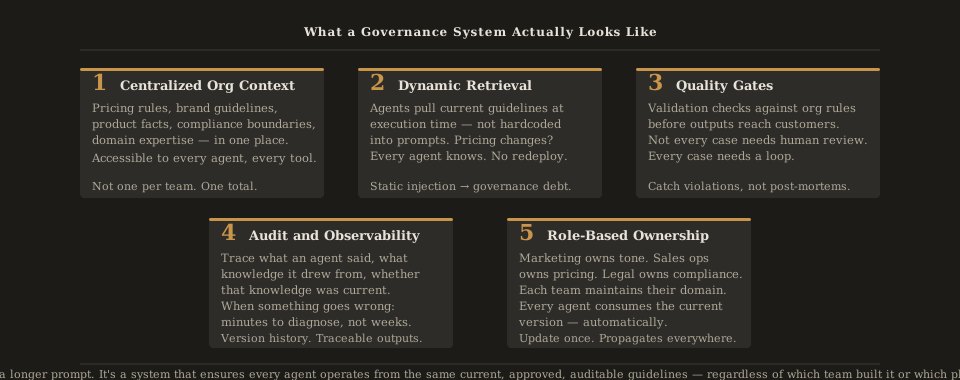
The teams getting this right are building a governance layer that sits between the organization's knowledge and the agent's behavior — a layer that any agent can connect to, regardless of the tool or platform it was built on. It typically includes:
-
Centralized organizational context: Pricing rules, brand guidelines, product facts, compliance boundaries, and domain expertise — maintained in one place and accessible to every agent across every tool.
-
Dynamic retrieval, not static injection: Instead of hardcoding knowledge into prompts, agents pull current guidelines at execution time. When pricing changes, every agent knows immediately. No redeployment. No copy-pasting across ten different prompts.
-
Quality gates: Validation steps that check agent outputs against organizational rules before they reach a customer. Not every use case needs human-in-the-loop review. But every use case needs a loop.
-
Audit and observability: The ability to trace what an agent said, what knowledge it drew from, and whether that knowledge was current and approved. When something goes wrong — and eventually it will — you need to know why in minutes, not weeks.
-
Role-based ownership: Marketing owns tone guidelines. Sales ops owns pricing. Legal owns compliance boundaries. Each team maintains its domain, and the governance layer ensures every agent, across every platform, consumes the latest version.
This isn't a new idea. It's how enterprise software has always worked for human teams: centralized policies, role-based access, audit trails, version control. The only thing that's new is extending that same rigor to autonomous agents.
The Governance Dividend
Here's what teams discover once they implement it: governance doesn't slow agents down. It makes them more useful. When every agent has access to accurate, current, approved organizational knowledge, the outputs converge. The sales agent and the support agent start giving the same answer, because they're drawing from the same source. Adoption goes up because people trust the output. Maintenance goes down because updates propagate automatically instead of requiring prompt rewrites across a dozen tools.
Gartner warns that over 40% of agentic AI projects are at risk of cancellation by 2027 if governance, observability, and oversight are not established early. The teams that avoid that fate won't be the ones with the best models or the most agents. They'll be the ones that answered a simple question before they scaled:
Who's actually in charge of what these agents say?
The model gives your agent capability. Memory gives it continuity. Governance gives it judgment. Skip any one of those, and the system eventually breaks in ways that are hard to detect and expensive to fix.
References
- Gartner — "Over 40% of Agentic AI Projects Will Be Canceled by End of 2027" (Jun 2025): https://www.gartner.com/en/newsroom/press-releases/2025-06-25-gartner-predicts-over-40-percent-of-agentic-ai-projects-will-be-canceled-by-end-of-2027
- Gartner — "40% of Enterprise Apps Will Feature Task-Specific AI Agents by 2026": https://www.gartner.com/en/newsroom/press-releases/2025-08-26-gartner-predicts-40-percent-of-enterprise-apps-will-feature-task-specific-ai-agents-by-2026-up-from-less-than-5-percent-in-2025
- Deloitte — "The State of AI in the Enterprise, 2026 AI Report": https://www.deloitte.com/global/en/issues/generative-ai/state-of-ai-in-enterprise.html
- McKinsey — "The State of AI in 2025: Agents, Innovation, and Transformation": https://www.mckinsey.com/capabilities/quantumblack/our-insights/the-state-of-ai
- MIT Technology Review — "From Guardrails to Governance: A CEO's Guide for Securing Agentic Systems" (Feb 2026): https://www.technologyreview.com/2026/02/04/1131014/from-guardrails-to-governance-a-ceos-guide-for-securing-agentic-systems
- Salesforce — "Less Hallucinations, More Trust: Salesforce's Path to Consistent Enterprise-Ready AI": https://www.salesforce.com/news/stories/combating-ai-hallucinations/