Your enrichment agent knows the CTO is evaluating three vendors. Your outbound agent sends a generic cold email anyway. This is how memory silos cost you deals.
TL;DR
- Memory silos are the #1 structural challenge when enterprises scale from one agent to many: each workflow learns, none shares.
- The cost isn't a catastrophic failure. It's a slow accumulation of generic emails, missed signals, contradictory messages, and stale intelligence — each survivable, compounding into real revenue loss.
- 38% of the insights that matter most — competitive signals, hiring patterns, qualitative observations — are long-tail facts that no schema anticipated. In siloed architectures, they're captured once and never seen again.
- Shared memory requires five things: entity-scoped storage, write-time extraction, cross-source deduplication, quality gates, and hard entity isolation.
The deal is worth $450,000. The CTO, according to the enrichment agent that ran on Tuesday, is actively evaluating three vendors. She publicly expressed frustration with her current provider's API reliability. Her team recently hired two platform engineers — a clear signal of active infrastructure investment.
On Wednesday, the outbound agent fires.
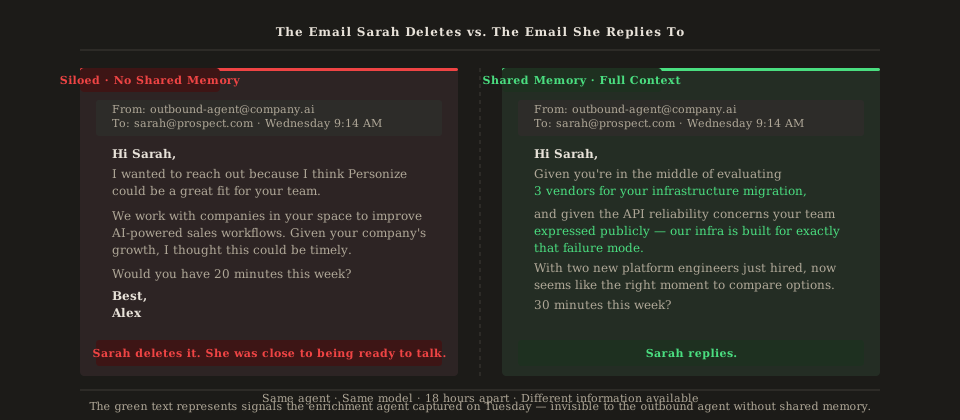
"Hi Sarah, I wanted to reach out because I think Personize could be a great fit for your team..."
Generic opener. No mention of vendor evaluation. No mention of API reliability. No acknowledgment of the infrastructure investment. The enrichment agent ran 18 hours ago and learned exactly the things a good sales email would address. The outbound agent has no idea any of that happened.
Sarah deletes the email. She was close to being ready to talk.
This Is Not a Hypothetical
The scenario above is constructed. The pattern is not.
VentureBeat described enterprise AI agents as "making enterprise-grade decisions on 20% of the information they actually need, with the other 80% completely invisible to them." That 80% isn't missing because it doesn't exist. It's missing because it lives in a different workflow.
Jade Global documented the specific failure mode: "A customer might report an issue via ServiceNow's AI-driven support tool, but Salesforce's sales team might not be aware of this issue, resulting in the customer receiving conflicting information or experiencing delays in resolution." Same customer. Different agents. No shared context.
WorkOS documented what it looks like quantitatively: within two months of deploying AI-powered lead scoring, the system was "recommending outreach to contacts who had changed roles, suggesting products to companies that had recently purchased competing solutions, and missing obvious buying signals from active prospects." The lead scoring model had no visibility into what the enrichment and support agents had already learned.
The cost of each incident is survivable. A generic email here, a missed signal there. But they compound — not visibly, not dramatically, but steadily. Teams stop trusting the agents for anything that matters. The AI investment produces activity but not outcomes. MIT's 2025 analysis found 95% of enterprise generative AI pilots reporting zero measurable ROI. The diagnosis is usually "the model isn't good enough." The real problem is often the architecture.
Four Agents, Same Account, Zero Shared Context
Let's trace what happens to a single account over six months:
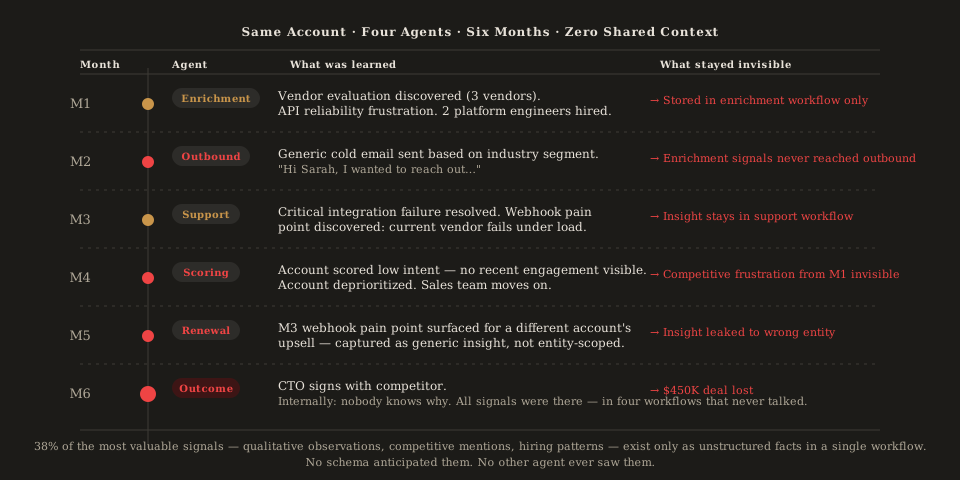
Month 1. Enrichment agent processes a LinkedIn update and two blog posts. Discovers the CTO is evaluating cloud migration vendors and has publicly criticized current API reliability. Stores this in its own memory. No other workflow can see it.
Month 2. Outbound sequence agent fires on the account. Sends a generic cold email based on industry segment. The CTO ignores it. The enrichment agent's intelligence never reached the outbound workflow.
Month 3. Support agent handles an inbound ticket from the same account. Resolves a critical integration failure and discovers a specific pain point: the current vendor's webhook infrastructure fails under load. Closes the ticket. The insight stays in the support workflow.
Month 4. Scoring model runs on the account. Assigns a low intent score because there's no recent engagement. The account is deprioritized. Nobody knows the CTO expressed competitive frustration two months ago.
Month 5. Renewal agent surfaces the same pain point resolved in Month 3 as a selling feature for a competitor account's upsell — because it was captured as a generic insight, not entity-scoped to the account where it was resolved.
Month 6. The CTO signs with a competitor. Internally, nobody knows why. The signals were all there, distributed across four workflows that never talked to each other.
What Gets Trapped in Silos
Not all trapped information is equal. The most valuable information is often the hardest to recover.Structured facts — a budget figure, a job title, a renewal date — can be manually entered into a CRM if someone thinks to do it. They're recoverable, with effort.
Long-tail insights are not. Across our controlled experiments on diverse content types, 38% of valuable information exists only as unstructured contextual observations: a CTO's frustration with API reliability, a competitor's failed implementation, a hiring pattern that signals infrastructure investment. No schema anticipated these. They appear in call transcripts and support tickets and LinkedIn posts and email threads. In a siloed architecture, they're captured once by whichever workflow processed that content, used once if the right question is asked at the right time, and then gone.
These are exactly the signals that separate a generic email from one the recipient actually responds to. They're also exactly the signals that disappear when workflows don't share memory.
Why Per-Agent Memory Isn't Enough
The frameworks are converging on agent-level memory: CrewAI, LangGraph, AutoGen, Letta all have some version of persistent memory for individual agents. This solves statefulness — an agent remembering across its own sessions. It doesn't solve organizational intelligence flow.
Giving every agent its own memory is like giving every employee their own private notebook and calling it institutional knowledge.The ICLR 2026 Workshop on Memory and Agents framed this precisely: teams need "transactive memory systems — knowing who knows what." LLM-based agents require the same: not just individual memory, but a shared layer where what one workflow learns is available to every other workflow acting on the same entity.
Microsoft, Amazon, Salesforce are all building toward this. But they're building walled-garden solutions: memory that works within their ecosystem and not across it. The silo problem moves up one level — from per-agent to per-platform.
What Shared Memory Actually Requires
The architectural requirements aren't complicated to describe. They're hard to build correctly.
Entity-scoped storage. Memory organized around the entities that workflows act on — customers, companies, deals — not around the workflows themselves. The enrichment agent's intelligence about Sarah should be available to the outbound agent, the support agent, and the renewal agent, because they're all acting on Sarah, not because they share a codebase.
Write-time extraction. When any workflow processes content about an entity, knowledge must be extracted and written to the shared store. A read path without a write path doesn't compound. This is the architectural line between retrieval and memory.
Cross-source deduplication. Multiple workflows processing overlapping content about the same entity will produce duplicate observations. In a controlled five-source experiment, 83% of candidate memories were near-duplicates of something already in the store. Without deduplication at write time, the store fills with noise and retrieval quality degrades silently over months.
Quality gates before storage. Not everything extracted belongs in persistent memory. Unresolved coreferences, temporal ambiguity, low confidence — these degrade retrieval for every downstream workflow. Write-time quality gates filter noise before it enters the store.
Hard entity isolation. Sharing memory across workflows for the same entity must not leak across entities. Under adversarial conditions — 100 entities in the same industry with overlapping names and similar roles — isolation must hold without relying on embedding distinctiveness. Zero cross-entity leakage across 3,800 results is the design constraint, not the benchmark aspiration.
The Email Sarah Would Have Responded To
With shared memory, the Wednesday outbound email looks different:
The agent retrieves Sarah's entity context before drafting. It knows about the vendor evaluation from Tuesday's enrichment run. It knows about the API reliability frustration from a public post six weeks ago. It knows the team hired two platform engineers last month. It knows there's a $450K migration budget from a deal signal captured in an earlier call.
The email it drafts references vendor evaluation timelines. It addresses API reliability as a specific capability. It acknowledges infrastructure investment as context for why this conversation matters now.
Sarah doesn't delete it. She replies.
The $450K email your AI sent wrong wasn't wrong because the model was bad. It was wrong because the model had 20% of the available context and no way to get the other 80%.
Frequently Asked Questions
Isn't this just a CRM sync problem? CRMs capture structured fields that someone enters manually. The 38% of insights that drive personalization — a CTO's frustration with API reliability, a hiring signal, a competitive mention in a support ticket — never make it into CRM fields. The problem is extracting, structuring, and sharing intelligence that no schema anticipated, automatically, across every workflow that touches the same entity.
What about frameworks like LangChain or CrewAI? They handle per-agent memory: an individual agent remembering across its own sessions. They don't handle cross-workflow memory, where what one agent learns is automatically available to every other agent acting on the same entity. The distinction is between individual statefulness and organizational intelligence flow.
How do you prevent memory from leaking between entities? Entity isolation must be architectural — enforced by storage-level scoping using CRM keys, not by embedding similarity. In a shared memory system serving thousands of entities, embeddings for similar entities (same industry, similar roles) are too close to rely on for isolation. Hard scoping by entity identifier is the only reliable mechanism.
How quickly does memory become available across workflows? Extraction and storage happen at write time, as each workflow processes content. There's no batch delay. If the enrichment agent processes content at 9am and the outbound agent runs at 11am, the outbound agent retrieves the enrichment agent's findings as part of normal entity context retrieval.