Inside the AI Coding Memory kit
Three views of the shared structure: records and collections, connected context, and the operating rules. This is the AI Coding Memory 1.2.0 schema from the author's implementation, separate from the smaller portable starter in this playbook.
Back to the playbook · Architecture for your AI · Portable starter
1. The memory model
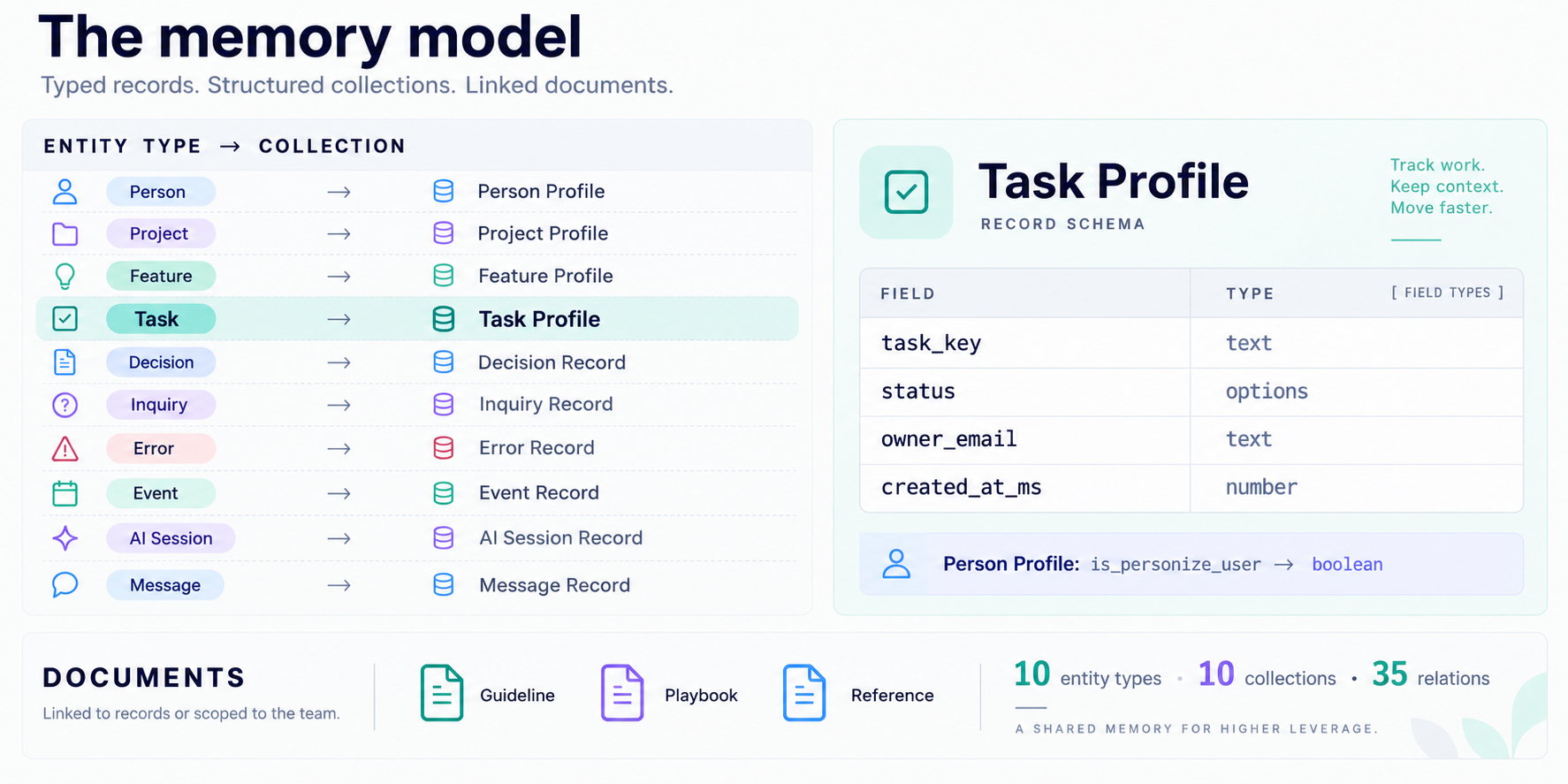
An entity type says what a record represents and how to identify it. A collection defines that type's structured properties. Documents retain reusable guidance or longer supporting material. Typed relations connect records so a session can retrieve the context relevant to its work.
The source declares 10 entity types, 10 collections, 35 relations and six guidance documents. Field types include text, options, number and boolean. Stable keys identify records; display titles can change. A Task Profile, for example, uses task_key (text), status (options), owner_email (text) and created_at_ms (number), alongside acceptance, verification and next-step fields.
The guidance documents use the platform's guideline and playbook content types. Specs, implementation plans and handoffs in the graph illustration are examples of supporting reference content. This kit registers no additional custom document types; those examples are not new entity types or new schema declarations.
2. Work becomes connected context
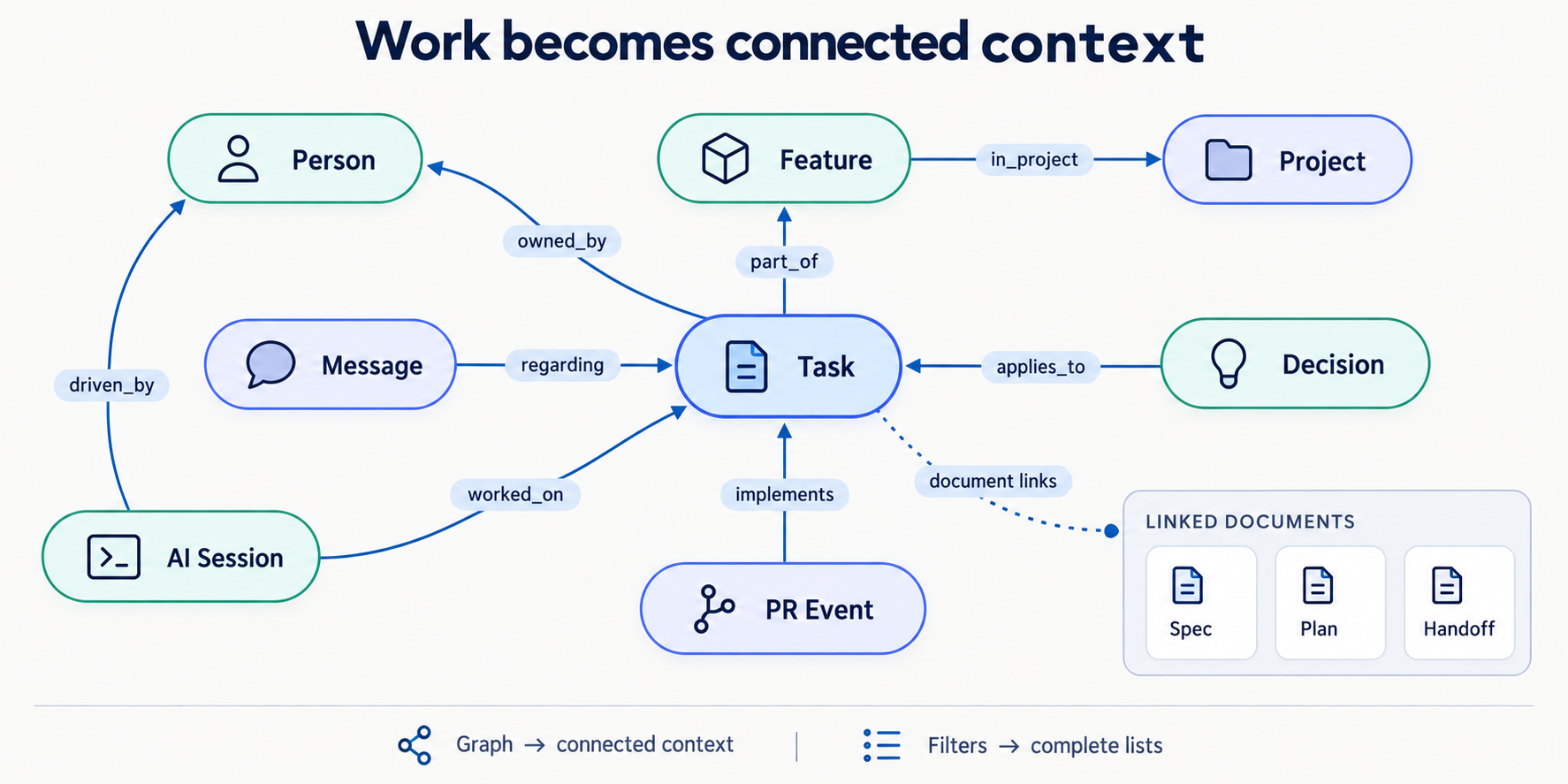
Read the arrows from their source to their target. A task is part_of a feature and owned_by a person. A session worked_on the task. A PR event implements it. A decision applies_to it, and a message is regarding it. A feature belongs to a project through in_project.
This is a synthetic example using eight declared relationships. It is not the full graph and contains no private work records. The dotted document link is a document attachment, distinct from a named relation between entity records.
Graph navigation answers “what context is connected to this record?” Complete questions such as “all open tasks in this project” use structured filters and full pagination. Core relations are mirrored by key properties so navigation and complete queries agree. Relationships are explicitly written and verified; the kit declares no automatic graph rules. A schema field by itself does not create an edge.
3. The operating rules
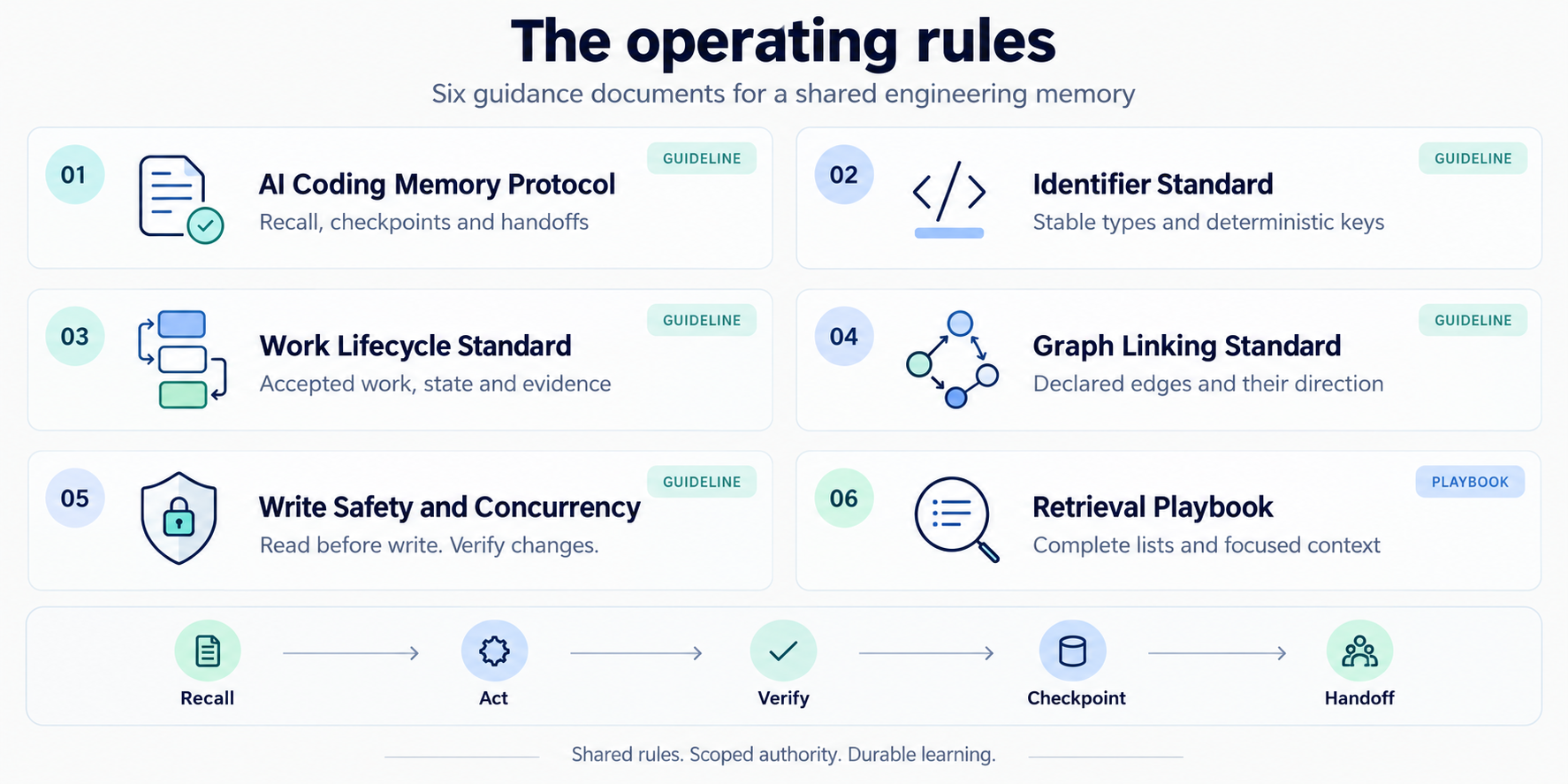
The six guidance documents explain how people and agents use the same records consistently:
| Document | Content type | What it covers |
|---|---|---|
| AI Coding Memory Protocol | Guideline | Recall, attribution, session checkpoints, handoffs and failure reporting |
| Identifier Standard | Guideline | Exact stable keys, typed identity and duplicate avoidance |
| Work Lifecycle Standard | Guideline | Accepted work, status transitions and completion evidence |
| Graph Linking Standard | Guideline | Declared relations, arrow direction, mirrored fields and verified links |
| Write Safety and Concurrency | Guideline | Read before writing, preserve changed state, verify writes and report failures |
| Retrieval Playbook | Playbook | Complete work lists, focused context, decisions, errors, handoffs and messages |
These are guidance documents, not an automatic enforcement engine. Local authorization governs each action. The current queue's write/wait/re-read claims do not establish atomic exclusivity across coordinators. The portable local adapter's conditional-update exercise has a different contract; production backends need their own qualification.
Entity and collection catalog
| Entity type | Stable key field | Collection |
|---|---|---|
person |
email |
Person Profile |
project |
project_key |
Project Profile |
feature |
feature_key |
Feature Profile |
task |
task_key |
Task Profile |
decision |
decision_key |
Decision Record |
inquiry |
inquiry_key |
Inquiry Record |
error |
error_key |
Error Record |
event |
event_key |
Event Record |
ai_session |
session_key |
AI Session Record |
message |
message_key |
Message Record |
Events represent identifiable occurrences such as PRs, commits, CI runs, deploys and releases. These are event kinds, not separate entity types in this kit. Inquiries cover proposals, hypotheses and questions. AI Session uses the actual type name ai_session; the portable starter's session is its own abstraction.
Relation catalog
The catalog below preserves the source's allowed types, direction and cardinality. Where several source/target types appear, read the relation's guidance for the meaningful pairing: duplicate_of, for example, is same-type; part_of means task → feature or commit event → PR event. A single-valued relation is limited to one current target; it is not evidence of an atomic claim or lock.
| Relation | Allowed source types | Allowed target types | Current targets |
|---|---|---|---|
in_project |
feature, task, decision, inquiry, error, event, ai_session, message | project | One |
part_of |
task, event | feature, event | One |
subtask_of |
task | task | One |
owned_by |
task, feature, error, inquiry, project | person | One |
created_by_person |
task, feature, decision, inquiry, error | person | One |
decided_by |
decision | person | Many |
directed_to |
inquiry | person | Many |
performed_by |
event | person | One |
reviewed_by |
event | person | Many |
driven_by |
ai_session | person | One |
has_manager |
person | person | One |
contributes_to |
person | project | Many |
blocked_by |
task, feature | task, feature, inquiry, error | Many |
depends_on |
feature | feature | Many |
duplicate_of |
task, error, inquiry | task, error, inquiry | One |
follows_up |
task | task, error, decision | Many |
related_to |
task, feature | task, feature | Many |
implements |
event | task, feature | Many |
fixes |
event | error | Many |
includes |
event | event | Many |
ships |
event | task, feature | Many |
rolls_back |
event | event | One |
seen_in |
error | task, feature, event, ai_session | Many |
introduced_by |
error | event | One |
tracked_by |
error | task | Many |
supersedes |
decision | decision | Many |
applies_to |
decision | feature, task, project | Many |
resolves |
decision, task, event | inquiry | Many |
concerns |
inquiry | task, feature, error, decision, event | One |
worked_on |
ai_session | task, feature, error, decision, inquiry, event, message | Many |
continues |
ai_session | ai_session | One |
sent_by |
message | person | One |
sent_to |
message | person | One |
replies_to |
message | message | One |
regarding |
message | task, feature, error, decision, inquiry, event | Many |
Source and adoption
The machine-readable map includes all entity/collection mappings, property names and types, relation definitions and guidance-document names. It excludes private records, identifiers, messages, credentials and transcripts.
Source: src/modules/actions/seed-data/kits/ai-coding-memory/kit.json at commit 48d788a0be3f0a94384ceb9c5939ad484db45e99, inspected October 14, 2026. The live Graph Linking Standard was also checked for arrow direction and the distinction between graph navigation and complete filtered lists. Schema counts describe this repository snapshot, not a receipt proving a particular live organization's installation.
The downloadable portable starter demonstrates local record and claim mechanics. It does not install this full production schema, semantically retrieve documents or enforce hosted permissions. Map the full model to the adopter's actual collections, native document types, authorities and concurrency contracts before relying on it.